Magic Item Generator
D&D 5e
Magic Item Generator
Roll up unique magic items with names, properties, and schools — click to copy
Free · No signup · Click any result to copy
Generate D&D 5e–style magic items with names, properties, schools of magic, and rarity tags. Filter by category, rarity, or school. Free, no signup.
Give that item a history — owners, lore, and where it ended up.
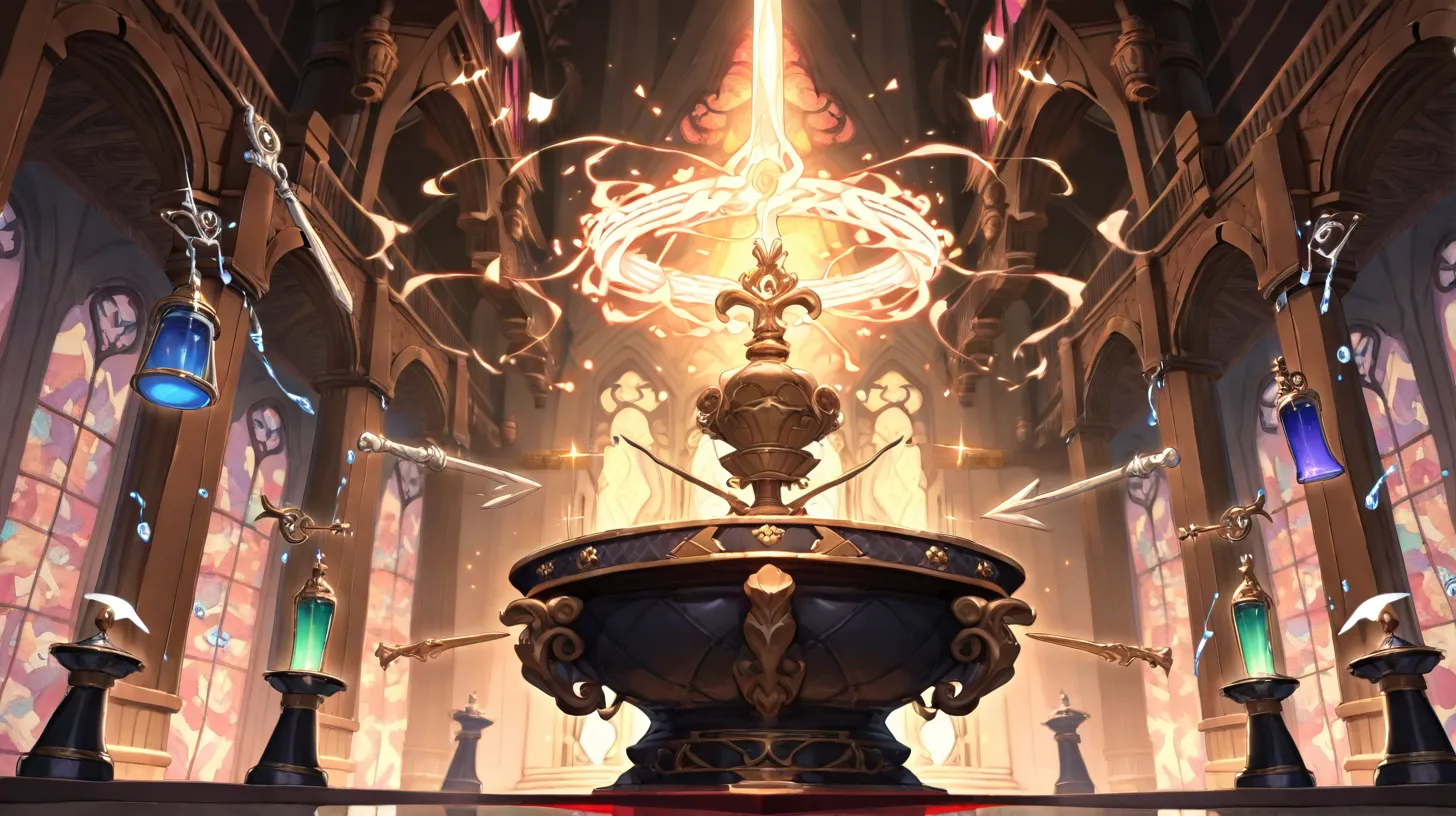
Need a magic item that fits this campaign, this level, and this rarity? This generator composes unique D&D-style magic items — name, category, rarity, school of magic, and a mechanical effect — in one click. Filter by rarity (common through legendary), category (weapon, armor, wondrous, ring, rod, staff, wand, potion, scroll), or school (abjuration through transmutation).
Each item generates with attunement flagged when appropriate, plus a description that suggests how it looks and how it works. Click any result to copy it to your campaign notes — drop it into your character sheet or your DM prep without retyping.
Pair with our Loot Generator for treasure hoards and the Quest Hook Generator for the adventure that earns the reward.
How Rarity Works in D&D 5e
Magic item rarity in 5e isn't a vibe — it's tied to a specific power band. Generated items follow the official rarity → power curve so they slot cleanly into existing campaigns:
| Rarity | Typical Effect | Suggested Level | Attunement |
|---|---|---|---|
| Common | Minor utility, narrative flavor | 1+ | Rarely required |
| Uncommon | +1 weapons, minor effects, spells once/day | 1–4 | Sometimes |
| Rare | +1 to +2, multiple uses, conditional bonuses | 5–10 | Usually |
| Very Rare | +2, powerful conditional or daily effects | 11–16 | Almost always |
| Legendary | +3, campaign-defining, often artifact-tier | 17+ | Always |
Use the rarity filter to match your party's level. Standard 5e parties find 1–3 uncommon items by level 5, 1–2 rare items by level 10, and the first legendary somewhere around level 15+ in most campaigns.
Schools of Magic and Item Flavor
The school selector lets you generate items thematically tied to a particular kind of magic — useful when you're building items for a specific NPC or location. Quick guide:
- Abjuration — protective: wards, resistances, anti-magic. Good for clerics, paladins, sword-and-board fighters.
- Conjuration — summoning, teleportation, creation. Often associated with warlocks and bards.
- Divination — knowledge, perception, foresight. Strong fits for wizards and rangers.
- Enchantment — charms, persuasion, mind-manipulation. Bards and sorcerers love these.
- Evocation — direct damage, elemental effects. The "blast wand" school.
- Illusion — invisibility, disguise, false images. Rogues and tricksters.
- Necromancy — life drain, death, undeath. Often DM-permission only at home tables.
- Transmutation — shape-changing, polymorph, alteration. Druids and chaos-leaning wizards.
Aligning an item's school to its bearer's class isn't required, but it gives the item narrative coherence. A Burning Flamebrand in a paladin's hand sings differently than the same blade in a rogue's.
Naming Magic Items in Your Campaign
Generated names are intentionally evocative but generic — they're a starting point. The most-remembered magic items have names that reference the campaign's history:
- Tied to a forge or smith. "Karenza's Last" — the final blade smithed by a dwarf the party met three sessions ago.
- Tied to a battle or event. "The Whitestone Promise" — recovered from the rubble of the city the party failed to save.
- Tied to a god or faction. "Pelor's Tear" — a relic of the sun god, found in a shrine that's been dark for decades.
- Tied to a former owner. "The Wraith's Wedding Band" — a ring that belonged to someone the campaign already cares about.
Take the generator's name as a placeholder, then rename to slot the item into the campaign. Our paladin guide and warlock guide include sections on signature-weapon design — magic items often turn into class-defining heirlooms.
Balancing Generated Items
Generated items follow the rarity curve, but they're a draft, not a final stat block. Two checks before adding to a live game:
- Compare to an existing official item of the same rarity. If an uncommon you generated does more than an uncommon Cloak of Elvenkind, consider scaling down.
- Check for stacking with the bearer's kit. An item that grants advantage on attacks, given to a Battle Master with Reckless Attack and Bless, may be too much.
When in doubt, talk it through with the DM (if you're a player) or run it past a co-DM (if you're the DM). Magic items shape long-term campaign math more than any single combat — getting them right pays off for the whole arc.
Where to Place Magic Items
Found items hit harder than gifted items. A few placements that always work:
- In the body of an enemy. Looted from the BBEG of a current arc — the item carries the weight of the kill.
- In an unexpected place. Old farmhouse cellar, abandoned monastery, forgotten library. The "why is this here?" question becomes a hook of its own.
- As a quest reward, but with strings. The duke gives the party the staff. The staff turns out to have been stolen from someone the party then meets.
- As a moral reward. The item appears only after a particular choice — sparing the villain, refusing the bribe, telling the truth.
For more on giving treasure narrative weight, see our Dungeon Master Toolkit and the complete DM guide.
A generated item becomes a legend when you give it a story.
Magic items are most memorable when they have a history. Anima lets you tie each item to a creator, a previous owner, a curse, a location — turning a one-line description into a thread the party chases.
- Save items as wiki entries with full descriptions, art, and rules text
- Link items to their creators, previous bearers, and the legends around them
- Track who currently holds each item across the campaign — no more lost magic
Free to start · No credit card · Your generated content stays free to use anywhere
Keep going
More free tools
D&D Dice Roller
Free online dice roller for D&D and any TTRPG. Roll d4–d20 and d100, build multi-dice pools, add modifiers, roll with advantage or disadvantage, and type full expressions like 2d6+3 or 4d6kh3.
D&D Encounter Builder
Free 5e encounter builder — pick party level, size, and difficulty (Easy / Medium / Hard / Deadly). The tool calculates XP thresholds and assembles a CR-balanced encounter in seconds.

D&D Spell Generator
Free D&D 5e–style spell generator. Pick level (cantrip → 9) and school of magic — get a complete spell with casting time, range, components, duration, and effect.
D&D Trap Generator
Free D&D 5e trap generator. Pick severity (Setback, Dangerous, Deadly) and character level — get DMG-balanced traps with triggers, damage, save DCs, and disarm hints.