How to Build a Campaign Setting From Scratch
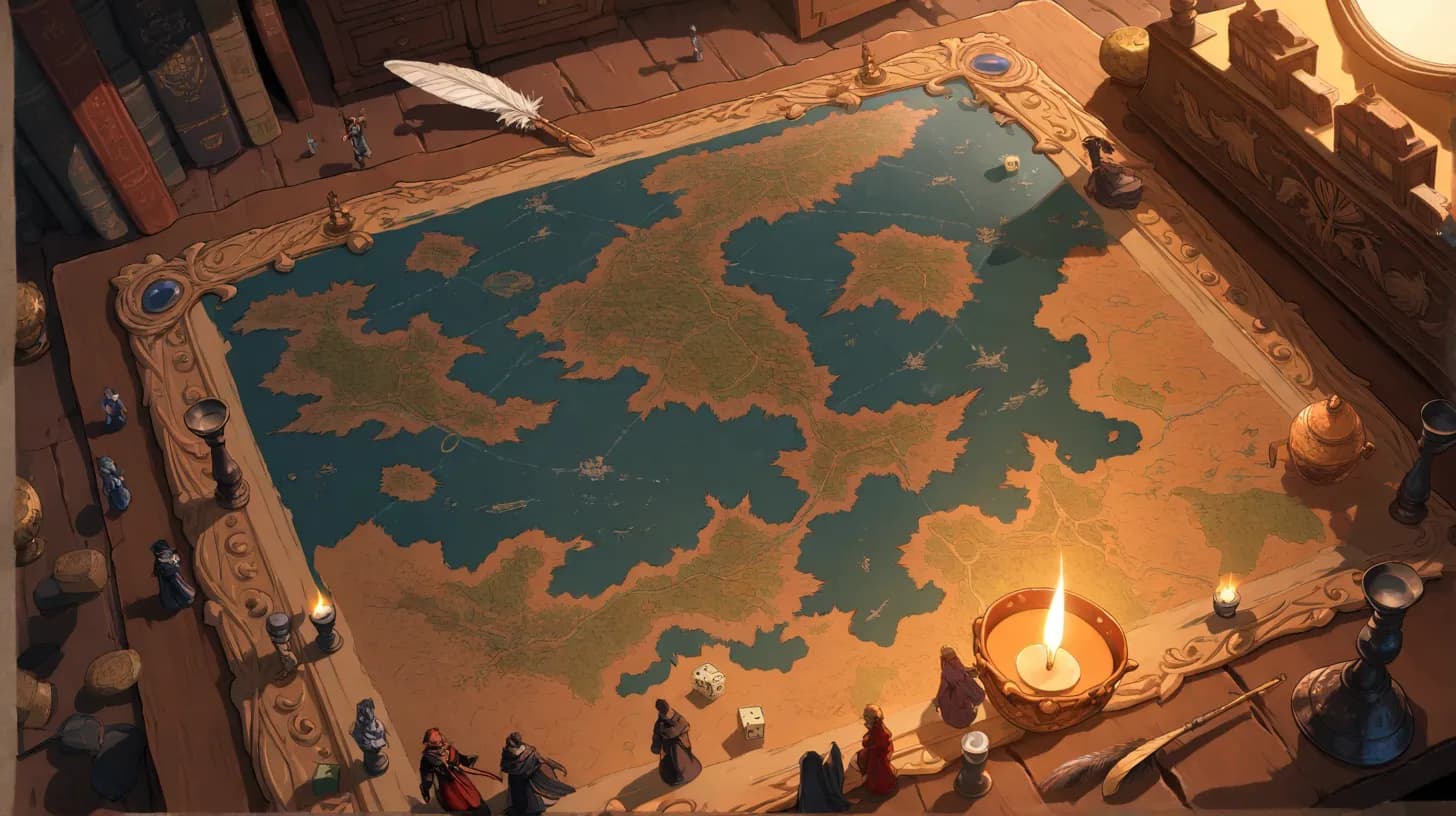
You could run your next campaign in the Forgotten Realms. There's nothing wrong with that — published settings exist for a reason. But there's a particular magic in hearing a player say "I've never seen anything like this world." An original campaign setting is yours. Every mystery has an answer you chose, every faction reflects a tension you care about, and every corner of the map hides something only you know.
Building a setting from scratch sounds like a colossal project. It doesn't have to be. You don't need a finished world to start playing — you need a foundation strong enough to support improvisation. This guide walks you through creating that foundation, step by step, from the first idea to a setting ready for session one.
Step 1: Find Your Core Concept
Every great setting starts with a single idea that makes it different. Not a geography lesson. Not a list of races. One sentence that captures the soul of your world and makes someone lean in.
- "Magic is a finite resource, and the last reserves are running out."
- "The gods died a century ago, and mortals are still fighting over the pieces."
- "Civilization clings to a chain of floating islands above a world swallowed by darkness."
- "An empire built on dragon-bonding is fracturing as the dragons begin to remember an older loyalty."
This is your world's thesis statement. Write it down. Put it somewhere you'll see it every time you sit down to work on your setting. It's a filter — when you're deciding whether a new idea belongs, ask yourself: does this reinforce the core concept or dilute it?
If you can't settle on one concept, write five, then cross out the four you'd be least excited to run for a full year. The one that survives is your world.
Step 2: Sketch the Map
You don't need a finished map. You need a shape — something to anchor your imagination in physical space. Grab a piece of paper, open a map maker, or use a procedural generator to get a starting point.
At this stage, you're placing only the big pieces:
- One or two continents or major landmasses
- Mountain ranges (these divide cultures and block weather patterns)
- Major rivers (civilizations cluster around these)
- One ocean or sea
- The region where your campaign starts — mark it, zoom in on it mentally
Don't detail the whole world. Detail the starting region and leave the rest vague. Empty space on a map isn't laziness — it's potential. You'll fill it as the campaign demands, and those improvised additions will feel more organic than anything you could have planned.
If cartography isn't your strength, procedural map generators can produce realistic terrain in seconds. Start with the generated geography and rename things, move borders, add your own landmarks. You're customizing, not creating from nothing — and the result will still be entirely yours.
Step 3: Build 3 Factions With Conflicting Goals
Factions are the engine of a living world. Three is the magic number — enough for complex politics, few enough to keep in your head. Each faction needs:
- A name and identity — what they call themselves, what others call them, and what they look like
- A goal — what they're actively trying to accomplish right now
- A method — how they pursue their goal (diplomacy, force, subterfuge, faith)
- A friction point — why their goal conflicts with at least one other faction
Example for a "dying magic" setting:
- The Conservators — hoard remaining magic in sealed vaults, believing strict rationing is the only way to survive. They want control.
- The Spark Seekers — believe new sources of magic can be discovered or created. They want exploration and experimentation, even if it's dangerous.
- The Unbound — believe magic's decline is natural and that society should adapt to a non-magical future. They want to dismantle the old power structures built on magic.
Notice how these factions aren't "good vs. evil" — they're perspectives in tension. Your players will have opinions about which faction is right, and those opinions might change. That's the mark of a setting that generates real stories.
Document each faction in your worldbuilding wiki with relations between them — who's allied, who's hostile, who's secretly negotiating. These relationships are the web your campaign's plot will hang on.
Step 4: Create 5 Locations That Tell Stories
Your starting region needs places players can go. Five is enough for the first arc — a home base and four destinations, each with its own character and purpose.
For each location:
- One sentence describing the vibe — "A mining town built into a cliff face, where the sound of pickaxes never stops." Don't write a paragraph; capture the feeling.
- One NPC who matters — the person players will interact with most. Name, role, personality, and one secret.
- One problem — something wrong that players might get involved in. Connected to a faction if possible.
- One sensory detail — what do you smell, hear, or feel in this place? This is what players will remember.
Link your locations to your factions. The mining town might be Conservator-controlled, with a secret Spark Seeker cell operating in the deep tunnels. The port city might be neutral ground where all three factions maintain embassies. Every location that connects to the faction web becomes a node in your campaign's story.
Step 5: Write a 100-Year History (In 10 Bullet Points)
You don't need an epoch-spanning chronicle. You need enough history to explain why the world is the way it is today. Ten events. That's it.
Focus on events that:
- Created the current power balance (who's in charge and why)
- Left unresolved tensions (old grudges, broken treaties, lost relics)
- Are within living memory for at least some characters (recent enough to matter emotionally)
A timeline turns a list of events into a visual story. When you can see that the Conservators seized power just ten years after the Great Fading, the political situation suddenly has weight — this isn't an ancient institution, it's a desperate power grab still within living memory.
Leave gaps in your history intentionally. "Something happened in the northern mountains 40 years ago — no one who went to investigate ever returned." Gaps are adventure hooks. They're questions your campaign will answer.
Step 6: Populate With Characters
You need people your players will talk to, fight, befriend, and betray. Start with these categories:
- 3 quest-givers — each connected to a different faction, each offering a different perspective on the world's problems
- 1 recurring villain or antagonist — not a dark lord; a person with understandable motivations who happens to be working against the party's interests
- 2 neutral NPCs — a merchant, a tavern keeper, a traveling bard — people who exist independent of the factions and give the world texture
- 1 mystery figure — someone whose allegiance and motives are unclear, who appears at unexpected moments
For each character, write: name, role, one personality trait, one goal, and one secret. That's enough to improvise any scene. You can use a NPC generator to spark ideas, then customize the results to fit your setting.
The real power comes from connecting characters to each other and to your factions. When the blacksmith's daughter is secretly a Spark Seeker, and the town guard captain is a Conservator loyalist, and the player characters are staying at the blacksmith's inn — you have a situation, not just a cast of characters.
Step 7: Define What Players Can Do (The Sandbox Menu)
Before session one, prepare a "menu" of 3-5 hooks — things players can pursue. Not a plot. Not a railroad. Options.
- "The Conservators are hiring guards for a magic vault transport — good pay, no questions asked."
- "A Spark Seeker scholar needs an escort to some ruins where she believes a new magic source was hidden."
- "Miners in the cliff town have broken through into something underground, and people are going missing."
- "An Unbound preacher is drawing crowds in the market square, and the town guard is getting nervous."
Each hook connects to a faction, a location, and at least one NPC. When players pick one, the others don't disappear — they advance in the background. The Spark Seeker still goes to the ruins; the miners still go missing. The world moves whether the players are watching or not.
Putting It All Together
You've now got:
- A core concept that makes your world unique
- A map with a detailed starting region
- 3 factions in tension
- 5 locations with their own character
- A 10-point history that explains the present
- 7+ NPCs connected to factions and locations
- A menu of hooks for session one
This is a campaign setting. Not a finished world — a living one that grows through play. Every session adds detail. Every player decision reshapes the map. Every NPC encounter reveals more about the factions. The world gets richer because it's being used, not because you spent six months alone with a notebook.
The key to keeping this alive is organization. When your setting exists as scattered notes in five different apps, you'll lose things. When it's in a connected system — wiki entries linked to map locations linked to timeline events linked to campaign notes — everything reinforces everything else, and the world becomes easier to run the longer the campaign goes.
Start with the core concept. Build outward from there. And run session one before you think you're ready — your players will ask questions you never considered, and their curiosity will build the world faster than you ever could alone.
Keep reading
More from this topic
How to Run a Session Zero (Checklist, Examples & Common Pitfalls)
Session zero is the single highest-leverage hour of any campaign. Skip it and you end up renegotiating expectations mid-fight six sessions in. Here's the checklist, the conversations to force, and the traps first-time GMs fall into.
Ultimate Guide: Campaign Management
Master campaign management for tabletop RPGs. Learn session planning, NPC tracking, quest management, and the best digital tools for running organized, memorable campaigns.
DnD Campaign Ideas: 50 Plot Hooks
Start building your world today
A linked wiki, a timeline and a live DM screen — free, in your browser, no account needed.