D&D Encounter Builder
D&D 5e
D&D 5e Encounter Builder
Build CR-balanced encounters in seconds — XP scales by party level, size, and difficulty
No encounter fits these parameters.
Free · No signup · Click any result to copy
Free 5e encounter builder — pick party level, size, and difficulty (Easy / Medium / Hard / Deadly). The tool calculates XP thresholds and assembles a CR-balanced encounter in seconds.
Save the encounters you actually use into a real campaign board.
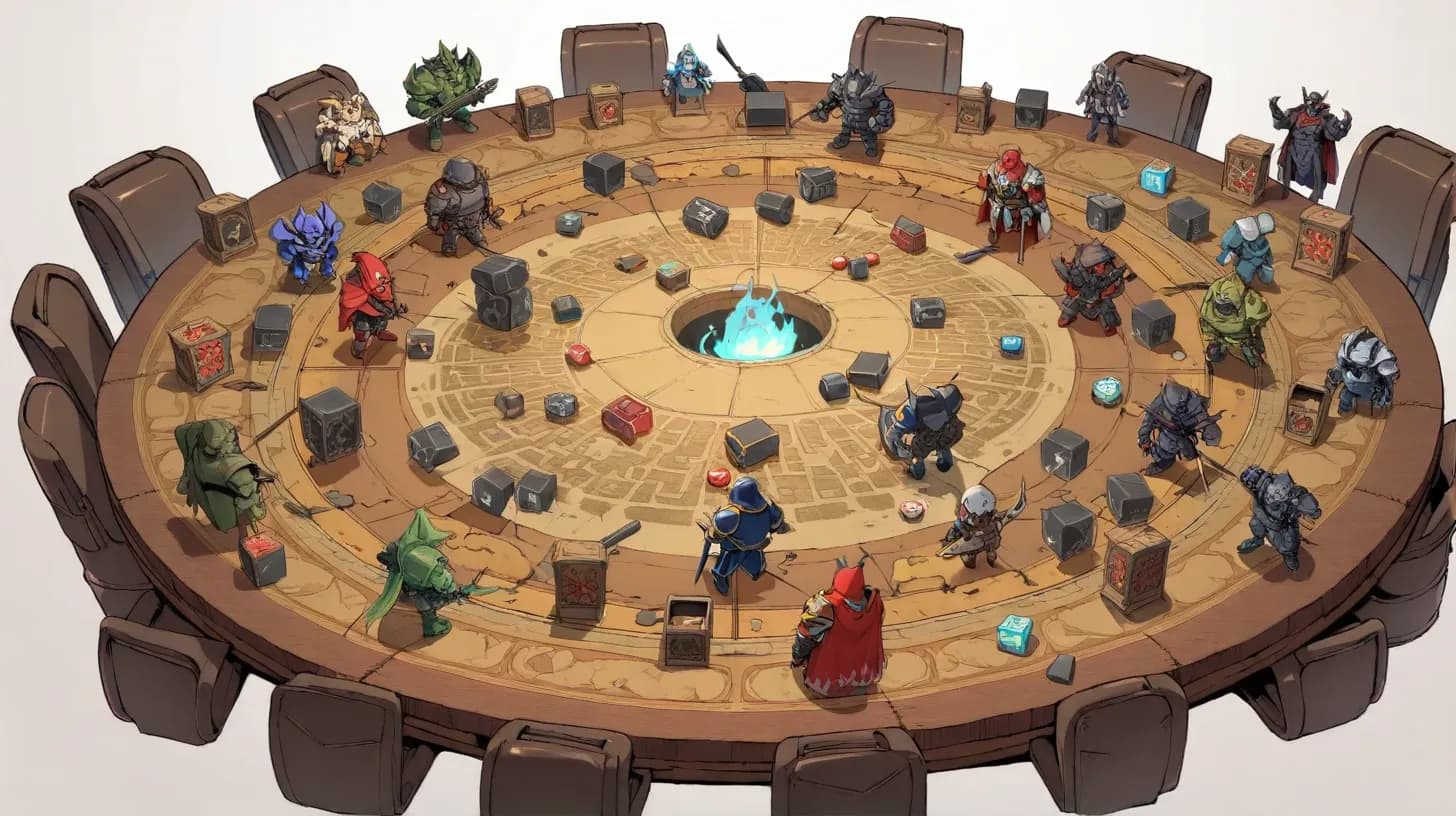
The hardest part of running a D&D session isn't writing the story — it's spending forty minutes on a calculator deciding whether two ogres and a troll will TPK your level-5 party. This encounter builder solves that math in one click.
Pick your party level (1–20), party size (2–8 PCs), and difficulty band (Easy, Medium, Hard, or Deadly). The builder uses the 5e DMG's XP thresholds × encounter multiplier formula to assemble a CR-balanced encounter — a boss, a boss with minions, or a horde — drawn from a curated monster pool filtered by your chosen environment (forest, dungeon, urban, mountain, swamp, underdark, coastal, desert, arctic, or any).
Each encounter shows raw XP, the multiplier applied, the adjusted XP, and the target XP for the difficulty selected — so you can see exactly why the math landed where it did. Click "Copy encounter" to drop the full block into your DM notes. Pair this with our Random Encounter Generator for narrative encounters and the Treasure Hoard Generator for the rewards.
How D&D 5e Encounter Balance Works
5e's encounter math is built on three numbers: XP per character, XP budget for the party, and the encounter multiplier. Get any of these wrong and your session's combat tension breaks.
| Difficulty | What It Means | Resource Cost |
|---|---|---|
| Easy | Some hits land, a slot might burn. | ~20% of party resources |
| Medium | Real tactical play. PCs will heal after. | ~40% of party resources |
| Hard | Healing matters, slot management matters. | ~60–70% of party resources |
| Deadly | A PC might fall. Plan exits or revivals. | ~80–100% — risk of death |
Standard guidance: budget 6–8 medium encounters per "adventuring day" (the span between long rests). Front-load the action and your party arrives at the boss spent — exactly the tension you want.
The Encounter Multiplier — Why More Monsters = More Dangerous
One CR-5 troll vs four PCs is medium. Four CR-1 brown bears vs four PCs is not equivalent, even though the raw XP is similar. The encounter multiplier accounts for action economy: more enemies means more attacks per round, more saves the party fails, more concentration broken.
- 1 monster — ×1 (the easy case)
- 2 monsters — ×1.5
- 3–6 monsters — ×2
- 7–10 monsters — ×2.5
- 11–14 monsters — ×3
- 15+ monsters — ×4 (this is where TPKs live)
The builder applies the multiplier automatically and shows you both raw and adjusted XP. For parties smaller than 3 or larger than 5, the multiplier shifts up (small parties suffer the multiplier harder) or down (large parties absorb it more easily).
Choosing Difficulty: The Hidden Lever
Difficulty isn't a slider you set once per campaign — it's a per-encounter choice that shapes the session's rhythm. A few patterns that experienced DMs use:
- Easy openers, medium escalation, hard finale. The classic three-act structure for a session: get the party into the scene with a manageable fight, ramp into something taxing, end on a fight that costs real resources.
- Deadly only when telegraphed. A surprise deadly encounter feels unfair. A telegraphed deadly encounter — the dragon's shadow on the wall, the warning the NPC gave them — feels like consequence.
- Stack mediums for attrition. Five medium fights in a row will drain a party harder than one deadly — and feels different at the table (grinding instead of climactic).
Beyond the Numbers — What Makes an Encounter Memorable
The math determines whether the party survives. What determines whether they remember the fight is everything the builder can't calculate for you:
- Stakes beyond HP. "Defeat the enemy" is forgettable. "Defeat the enemy before the bridge collapses behind the prisoner" lives in players' memories for years.
- Terrain that does work. A 20-foot ravine running through the encounter changes positioning for the entire fight. A single object — a chandelier, a brazier, a stack of barrels — turns a brawl into a set piece.
- An enemy who talks. A monster that calls for surrender, mocks a PC by name, or invokes a god mid-fight transforms combat into character moment.
- Consequence after. Who escapes? Who watched the fight? Does the village hear about it? The most-remembered encounters echo into the next session.
Use the builder to handle the math. Use your prep time on the parts the math can't reach. For more on running combats that land, see how to run a D&D session.
Building Custom Encounter Tables
The encounter builder is great for ad-hoc combat prep. For a campaign's recurring threats — the bandit lord, the cult, the rival adventurer party — invest in a custom encounter table. The structure that works:
- List the campaign's six recurring threats. These are the factions and monsters that define your setting.
- Build three difficulty variants per threat. Patrol, full warband, leader plus elites.
- Roll on the table during travel or downtime. The builder gives you new fights; the custom table gives you continuity.
Pair encounter design with quest hooks and loot, and you have the full DM prep loop. For deeper guidance, see the Dungeon Master Toolkit hub.
A balanced encounter is the start. Make it part of a campaign.
The XP math is solved. What's harder is remembering which encounter your party survived, which one almost killed them, and which enemy escaped to return three sessions later. Anima keeps that thread alive.
- Save encounters into a session-prep board you can pull from for years
- Link enemies to your monster wiki, locations to your map, and survivors to future arcs
- Plan multi-session arcs where each encounter raises the stakes for the next
Free to start · No credit card · Your generated content stays free to use anywhere
Keep going
More free tools
D&D Dice Roller
Free online dice roller for D&D and any TTRPG. Roll d4–d20 and d100, build multi-dice pools, add modifiers, roll with advantage or disadvantage, and type full expressions like 2d6+3 or 4d6kh3.

D&D Spell Generator
Free D&D 5e–style spell generator. Pick level (cantrip → 9) and school of magic — get a complete spell with casting time, range, components, duration, and effect.
D&D Trap Generator
Free D&D 5e trap generator. Pick severity (Setback, Dangerous, Deadly) and character level — get DMG-balanced traps with triggers, damage, save DCs, and disarm hints.
Dungeon Generator
Free dungeon generator for D&D and TTRPGs. Pick size (small, medium, large) and theme (ruins, crypt, cave, temple, fortress, sewer) — get a procedural dungeon with rooms, encounters, traps, and loot.