Drukhari (Dark Eldar) in Warhammer 40K: Commorragh, Kabals, Wych Cults & Covens
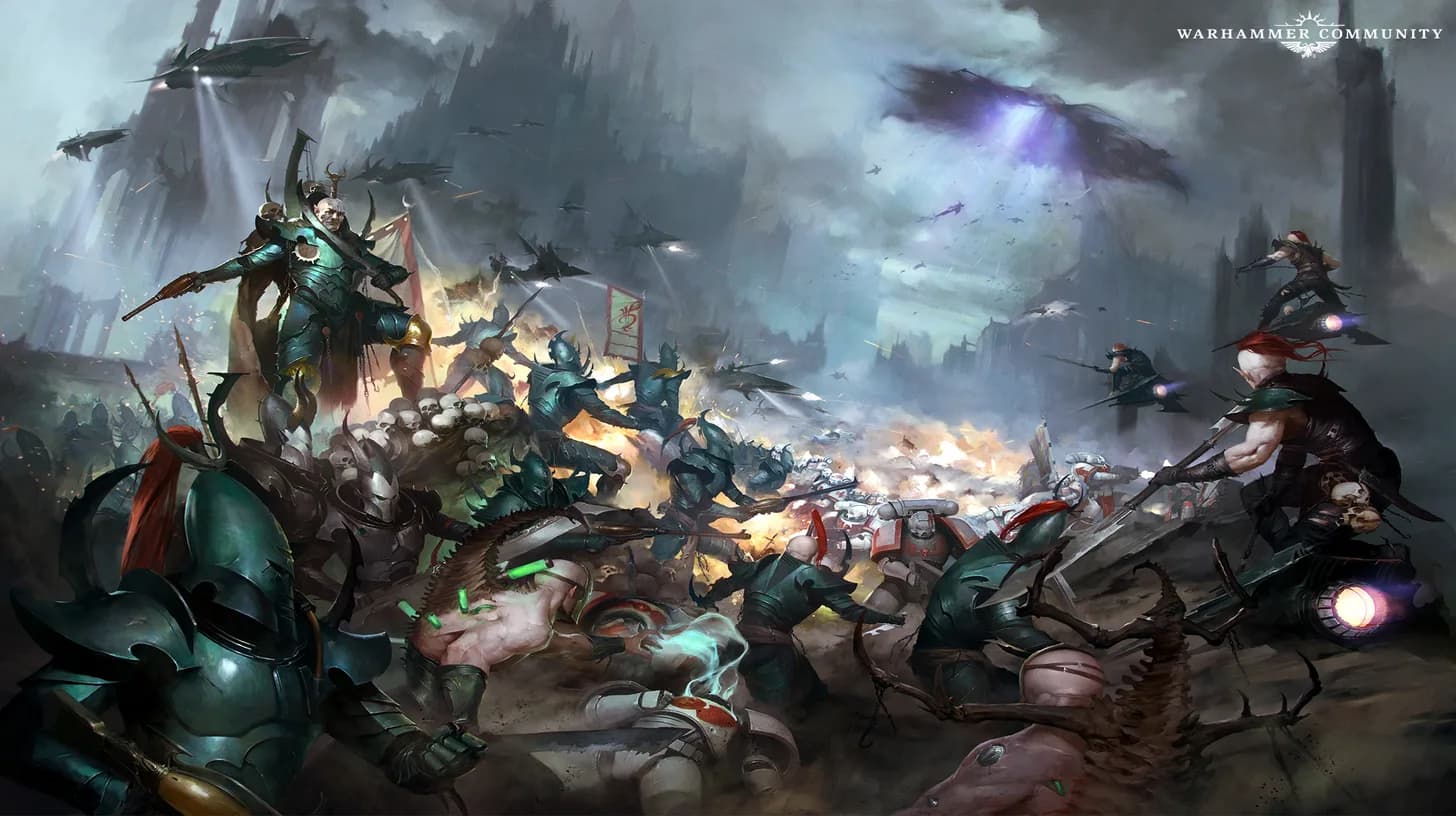
The galaxy of Warhammer 40,000 is a tapestry of cruelty, but few of its threads are dyed in shades quite so depraved as those of the Drukhari. Among the great 40K factions, they are the corsairs of nightmare — an ancient and beautiful people who long ago looked upon damnation and decided not to flee it, nor resist it, but to feed upon the suffering of others so that they might live forever. They are pirates, slavers, torturers and artists of pain, and they regard the murder of a thousand worlds as a passing amusement.
To understand the Drukhari is to understand the Aeldari, for they are the same race split along a single, terrible fault line. Where their Craftworld kin answer their shared curse with mournful discipline and rigid self-denial, the Drukhari answer it with appetite. They are the dark mirror held up to the wandering Aeldari — the same exquisite cruelty that once doomed an empire, but unrepentant, unbound, and gleeful. To gaze into that mirror is to see what the Aeldari might have become entirely, had not a fraction of them found the strength to turn away.
Drukhari at a Glance
| Aspect | Description |
|---|---|
| Origin | Aeldari who survived the Fall by dwelling within the webway, rather than fleeing on the craftworlds |
| Home | Commorragh, the Dark City, hidden deep within the webway |
| Nature | Raiders, slavers and hedonists; sadism is survival, not mere vice |
| The Three Pillars | Kabals (political-military power), Wych Cults (arena warriors), Haemonculus Covens (flesh-sculptors and torturers) |
| Defining Drive | To stave off Slaanesh's hunger by feeding on the agony and suffering of others |
| Greatest Fear | The slow devouring of their souls by Slaanesh — true, final death |
| Supreme Overlord | Asdrubael Vect, the lowborn schemer who rules the Dark City |
| Signature | Lightning raids, splinter and poison weapons, speed, shadow and treachery |
Children of the Fall
The Drukhari were born of the same catastrophe that shattered the Aeldari empire. At the height of their dominion, the Aeldari grew decadent beyond measure, indulging every cruelty and excess until their collective passions began to coalesce in the immaterium. From that boiling sea of sensation, a new god was born screaming into existence — Slaanesh, the Dark Prince, whose birth-shriek tore a wound in reality and consumed the souls of nearly an entire species in an instant. This was the Fall, and it remains the defining wound of the Aeldari race.
Some Aeldari escaped. The most ascetic had already fled aboard the vast world-ships called craftworlds, sailing into the void before the end came. But others survived by a different accident of fate. Deep within the webway — the vast labyrinth of tunnels woven between realspace and the warp — there dwelt Aeldari who had built private kingdoms of pleasure far from their dying homeworlds. When Slaanesh awoke, the webway sheltered them. They endured the unendurable, and emerged into the aftermath unrepentant. These survivors became the Drukhari. To grasp the forces that shaped them, it is worth reading the Chaos Gods guide and, above all, the lore of Slaanesh, for the Dark Prince is the eternal shadow over everything they are.
The Soul-Thirst
Every Aeldari soul shines too brightly in the warp, and Slaanesh hungers for that brilliance above all other prey. From the moment of birth, each member of the race is marked for consumption; in death, their spirit risks being dragged into the Dark Prince's clutches and devoured for eternity. This is the curse the entire species shares, and it is the central horror of their existence.
The Craftworlders answer this doom with austerity. They walk the rigid Path, mastering their every emotion, and cage their souls in spirit stones to cheat Slaanesh of His meal. The Drukhari find such discipline contemptible. Yet they suffer the same slow erosion — Slaanesh feeds upon their living essence by degrees, withering them from within, draining the vitality from their immortal frames until they fade. To resist this, the Drukhari discovered a monstrous remedy. They learned that by inflicting agony upon others and bathing in the psychic resonance of pain, terror and despair, they can replenish what Slaanesh steals. The suffering of captives rejuvenates them, restoring beauty and vigour, holding the soul-drain at bay.
This single fact is the engine of their entire civilisation. Their cruelty is not a flaw but a necessity; their sadism is metabolic. A Drukhari who ceases to feed begins to age, to shrivel, to dim — and so they must forever harvest fresh anguish, an addiction without end. Immortality, for them, is something purchased perpetually with the screams of others.
Commorragh, the Dark City
The heart of Drukhari power is Commorragh, a sprawling, vertiginous metropolis hidden within the folds of the webway. It is a city without sun or sky, a labyrinth of spires, arenas, pleasure-palaces and bottomless drops, stitched together across countless sub-realms and stolen pockets of space. It lies outside the ordinary flow of time and, most crucially of all, beyond the gaze of Slaanesh and the other Chaos Gods. Within the webway's shadow, the Dark City is invisible to the very god that would devour its inhabitants — a sanctuary built inside the wolf's blind spot.
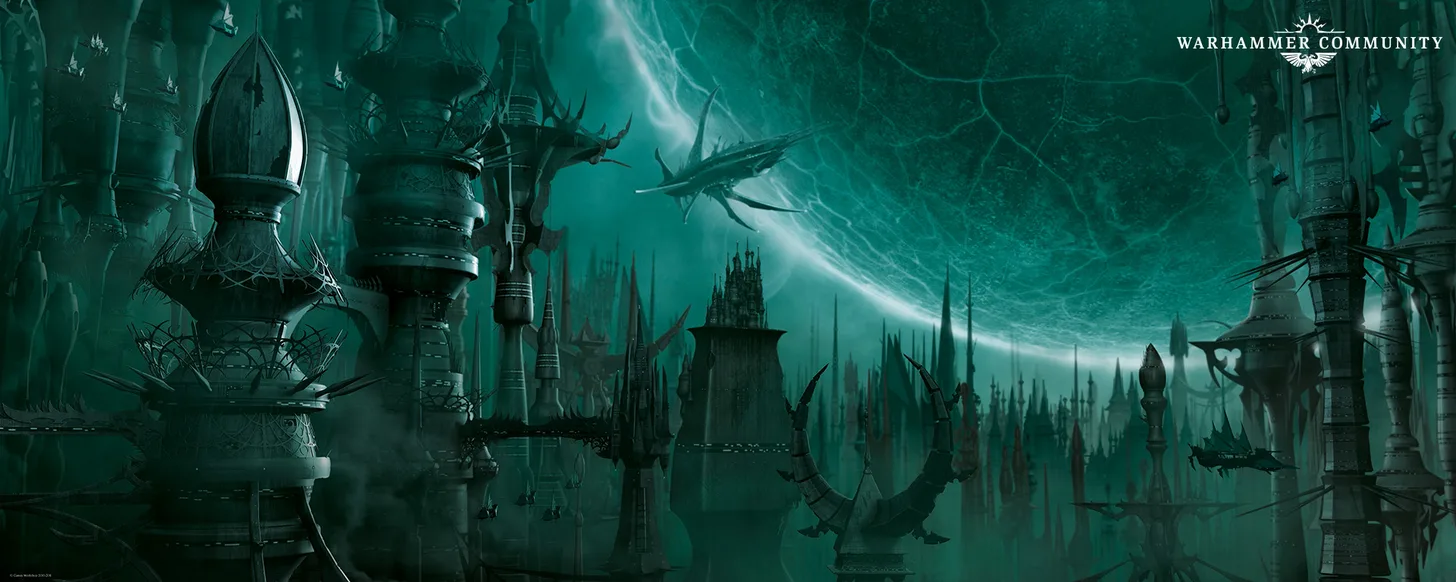
Commorragh is impossibly ancient and almost beyond mapping, its true extent unknown even to those who rule it. From this hidden bastion the Drukhari watch the galaxy through ten thousand secret portals, choosing their prey at leisure. The city is at once their fortress, their marketplace and their grand theatre of torment, where slaves are bought and sold, where the arenas roar, and where the great powers of their kind scheme endlessly against one another.
The Raids
The Drukhari do not wage war for territory or conquest. They raid. From the mouths of the webway they erupt into realspace without warning — swift, silent and merciless — descending upon a world, a void-station or a fleet in a storm of bladed craft. Their technology favours speed above all: skimming vehicles that move like loosed arrows, weapons that fire shards of poisoned crystal, and devices that drink in light and sound so their attacks come from nowhere. A raid is over almost before its victims understand they are under attack.
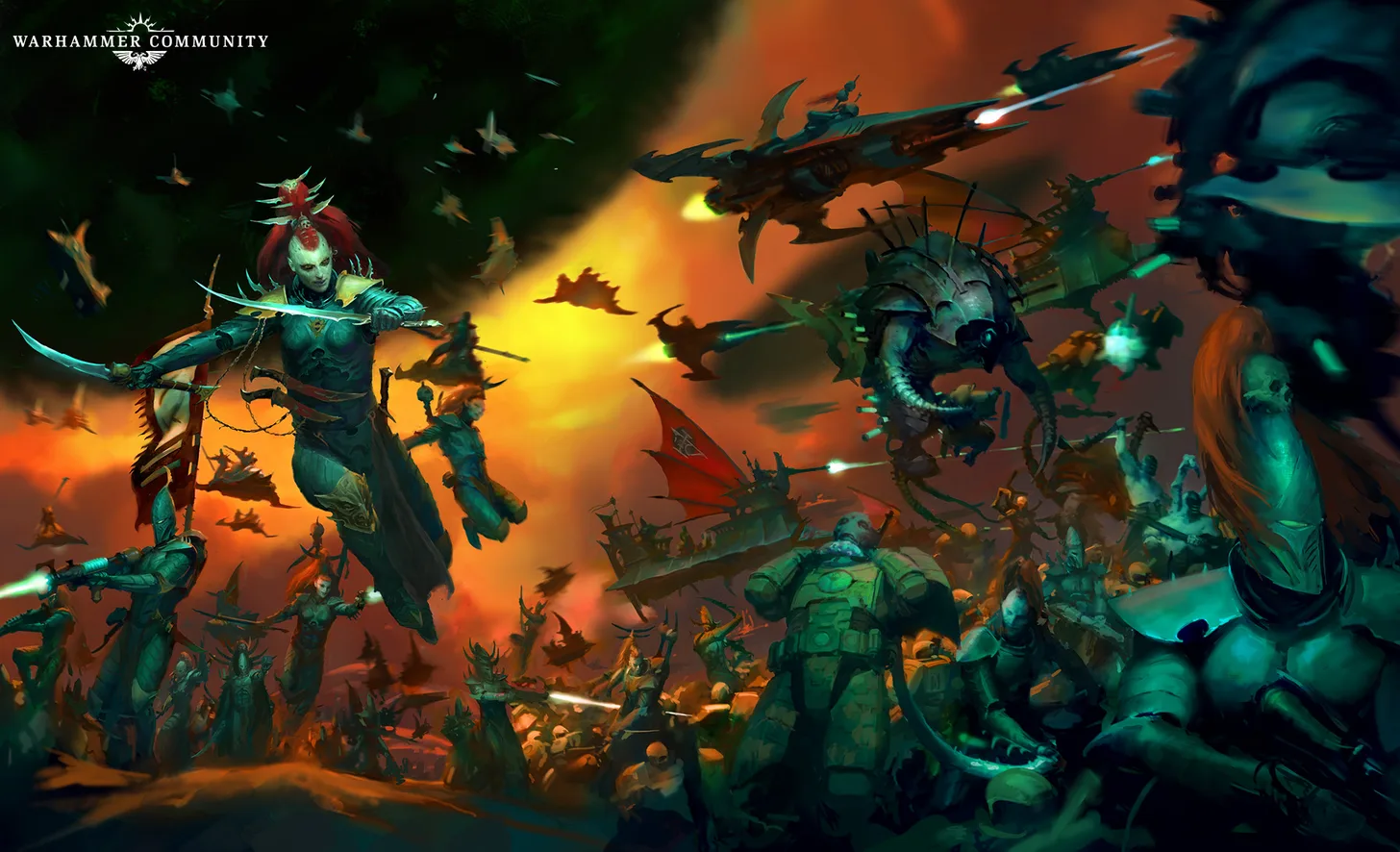
Their purpose is harvest. They seize captives by the thousand — soldiers, civilians, whole populations dragged shrieking through the portals — and vanish back into the webway before any relief can come. The taken are borne to Commorragh to feed the arenas, to be remade in the covens, or simply to be kept as slaves whose suffering nourishes their masters. No defender is safe from them; even the Space Marines of the Imperium, those transhuman warriors who turn back nightmares, have found whole companies whittled away by foes they could never quite catch. To the Drukhari, the mightiest enemy is merely a more interesting prize.
The Three Great Powers
Drukhari society is dominated by three rival institutions, each ancient, each jealous of the others, each bound to the harvest of pain in its own way. Together they form an uneasy and ever-shifting balance of power across the Dark City.
The Kabals
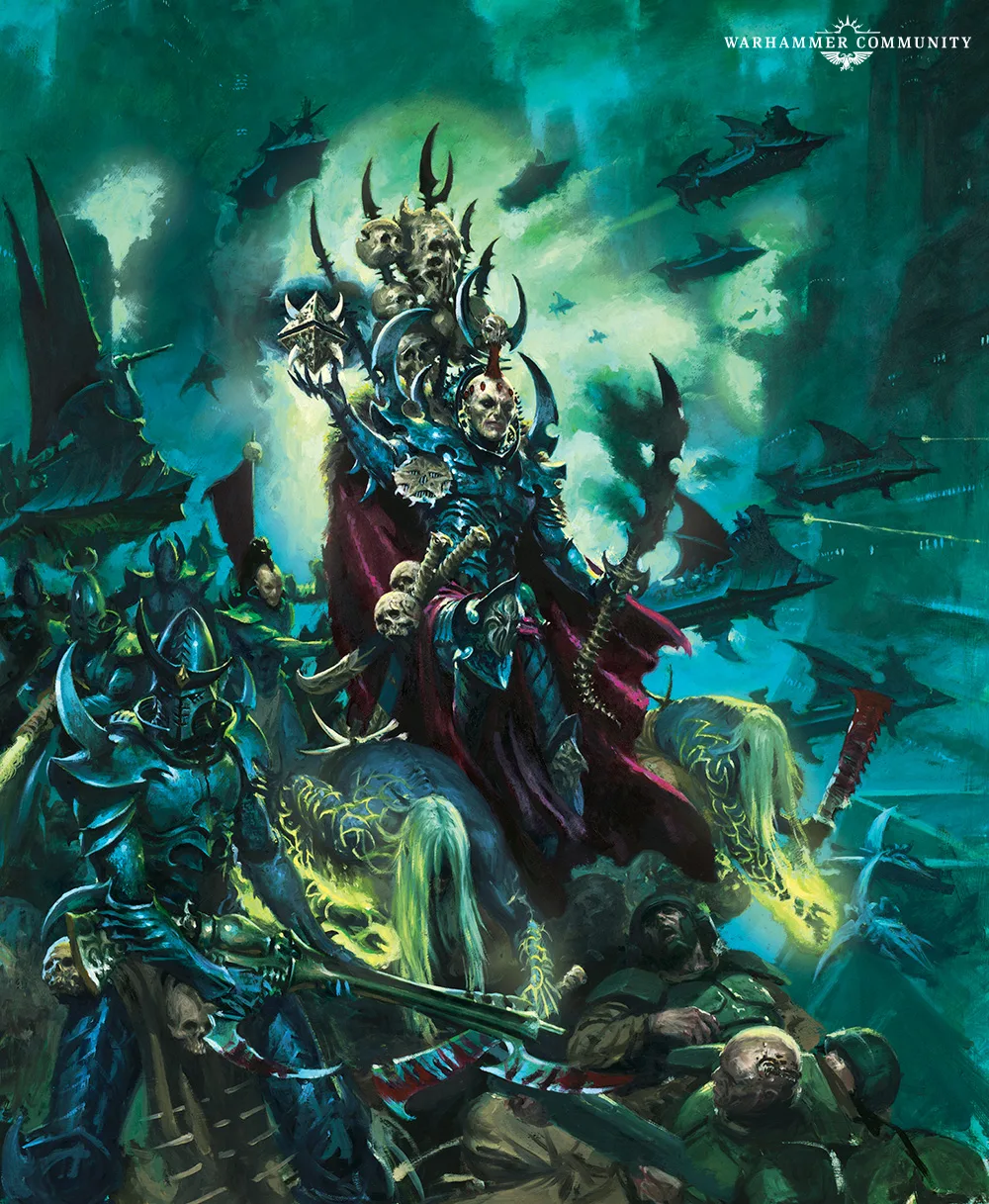
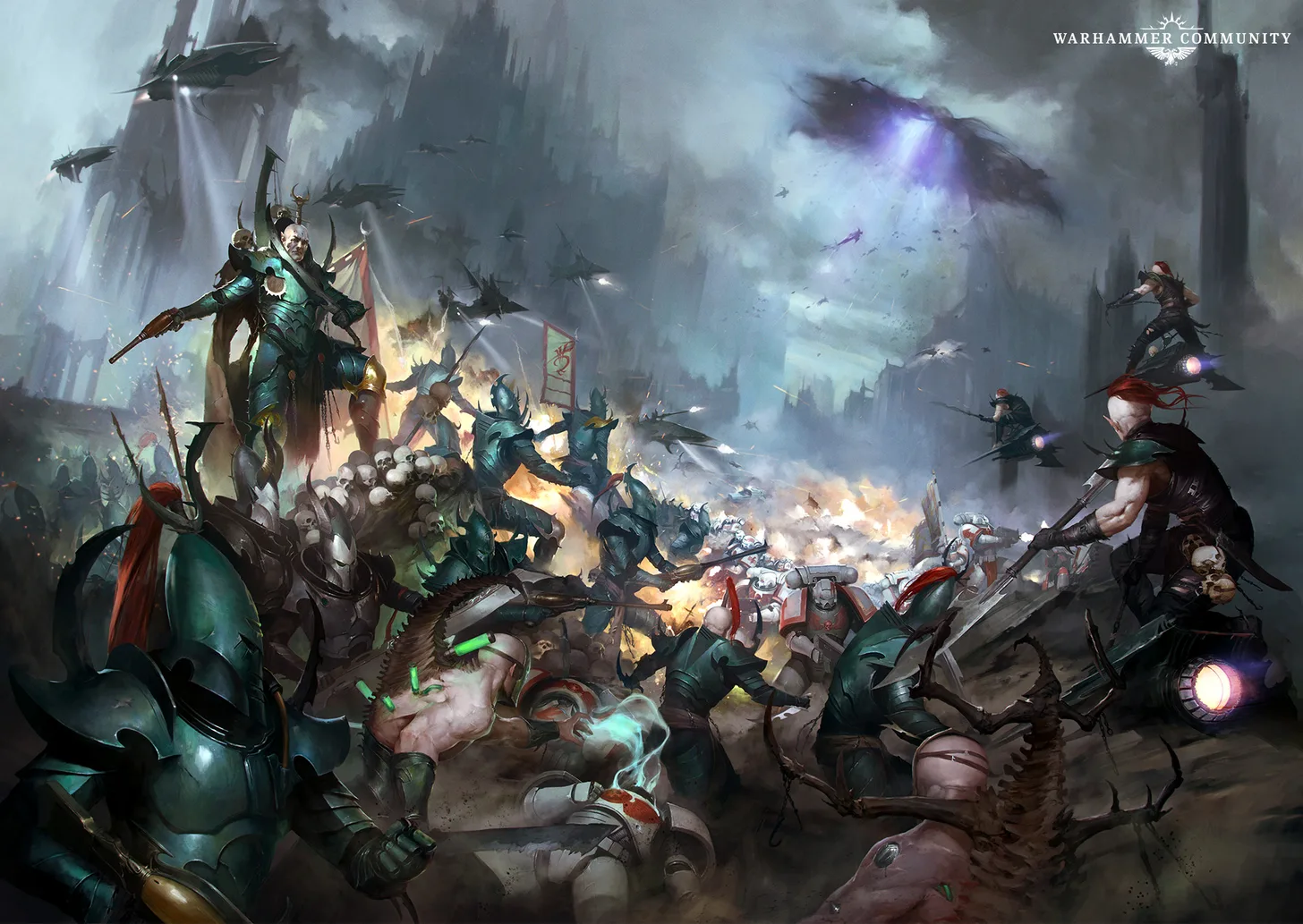
The Kabals are the political and military power blocs that truly rule Commorragh — armed dynasties of warriors, intriguers and aristocrats bound by oaths of loyalty that are, in practice, only as strong as fear can make them. A Kabal commands fleets, soldiers and vast wealth in slaves, and its Archon claws his way to power through a relentless calculus of murder, blackmail and betrayal. The mightiest of all is the Kabal of the Black Heart, whose dominance over the Dark City has lasted longer than the memory of many lesser empires. To rise within a Kabal is to walk forever among knives.
The Wych Cults
The Wych Cults are the gladiatorial heart of Drukhari culture — warrior-performers who turn slaughter into spectacle in the great arenas. Lithe, acrobatic and supremely skilled in close combat, the Wyches fight unarmoured and unafraid, dancing through volleys of fire and reaping captives before roaring crowds who feast upon the bloodletting. Their displays are at once sport, religion and a sacred feeding-ritual, for the agony of the arena nourishes every spectator. The Cult of Strife is among the most renowned, its champions adored and envied throughout the Dark City. The Wyches embody the Drukhari ideal of beauty and death made into a single, exquisite art.
The Haemonculus Covens
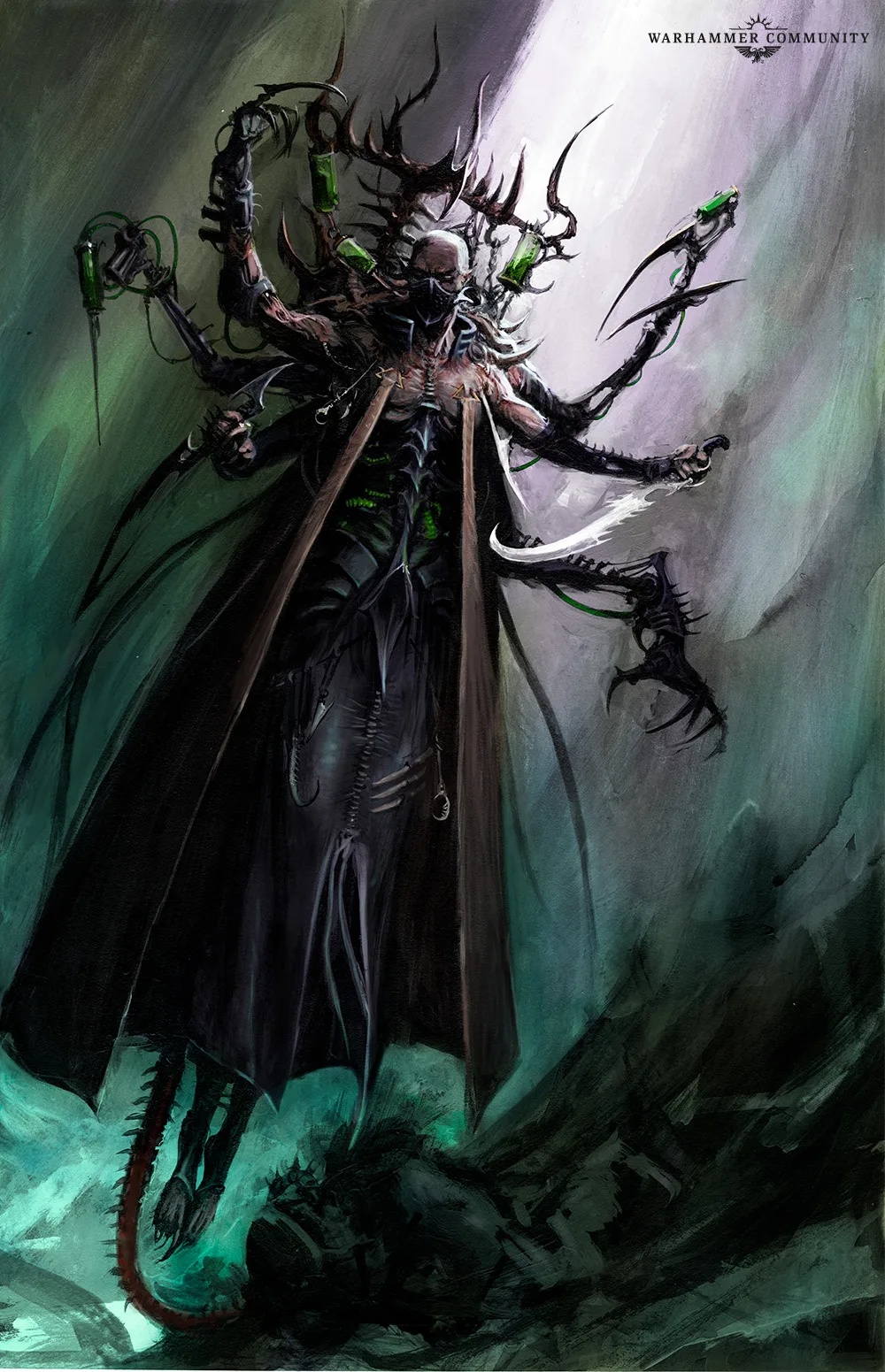
The Haemonculus Covens are the oldest and most unsettling power of all — ancient flesh-sculptors, surgeons and torturers whose mastery over living biology borders on the divine. A Haemonculus can rebuild a body from ruin, reshape it into monstrous new forms, and even restore the dead to life, granting a measure of true immortality to those who can pay his terrible price. The covens trade in pain and biology, growing new horrors in their subterranean laboratories and selling resurrection to Archons who would otherwise fear assassination. So fearful is their craft that even other Drukhari, who fear almost nothing, tread carefully around the Haemonculi. They are the keepers of the ultimate secret: how to cheat death itself, again and again.
Kabals, Cults and Covens at a glance
| Power | Led by | What they bring to a raid | Famous examples | Weakness |
|---|---|---|---|---|
| Kabals | Archon | Kabalite Warriors and Trueborn with splinter rifles and dark lances; Raiders and Ravagers; the fleet itself | Black Heart (Vect), Flayed Skull, Obsidian Rose, Poisoned Tongue, Last Hatred | Assassination from within; an Archon who loses face loses everything |
| Wych Cults | Succubus | Wyches, Hellions, Reavers, Beastmasters; the fastest close-combat troops in the game | Cult of Strife (Lelith Hesperax), Cursed Blade, Red Grief, Wrath Unbound | Unarmoured; one volley on the approach can end a squad |
| Haemonculus Covens | Haemonculus | Wracks, Grotesques, Talos and Cronos Pain Engines; resurrection for anyone who can pay | Prophets of Flesh (Urien Rakarth), Dark Creed, Coven of Twelve, Black Descent | Slow; despised even by other Drukhari |
Asdrubael Vect, Master of the Dark City
Above the endless feud of Kabals, cults and covens sits one figure: Asdrubael Vect, the supreme overlord of Commorragh and the founder of the Kabal of the Black Heart. Vect's tale is, by Drukhari standards, a heresy of ambition — for he was lowborn, a creature of the city's lowest depths who possessed no birthright, no ancient name, nothing but a will of pure adamant and a genius for treachery without equal.
Through schemes spanning millennia — assassinations, manipulations, betrayals layered within betrayals — Vect toppled the old aristocracy and bent the Dark City to his rule. He has died and returned, fallen and risen, and outlasted every rival who believed themselves his master. To the Drukhari, who prize cunning above almost all other virtues, Vect is the apex predator made manifest: proof that in Commorragh, blood means nothing and ruthlessness means everything. He rules not by love nor even by fear alone, but by the certainty that he is always, inevitably, three moves ahead.
Drukhari Units and Army Overview
A Drukhari army is a raid, not a battle line. Everything arrives fast, hits once, and leaves before the enemy has finished reacting. The roster reflects the three powers: Kabals bring the guns and the transports, Cults bring the blades, Covens bring the things that will not die.
| Unit | Power | Role | Signature |
|---|---|---|---|
| Archon | Kabal | Warlord, buffs Kabalites | Huskblade, shadowfield (2+ invulnerable until it fails) |
| Kabalite Warriors | Kabal | Core infantry | Splinter rifles: poison that wounds anything with a heartbeat |
| Raider / Venom | Kabal | Open-topped transports | Fast skimmers; passengers shoot from aboard |
| Ravager | Kabal | Tank hunter | Three dark lances |
| Scourges | Kabal | Winged heavy weapons | Deep-striking dark lances or haywire blasters |
| Succubus | Wych Cult | Melee warlord | Arena champion; rerolls and combat drugs |
| Wyches | Wych Cult | Melee infantry | Dodge saves, no-escape grapples |
| Hellions / Reavers | Wych Cult | Skyboard and jetbike skirmishers | Hit-and-run; Reavers cut with blade-vanes on the move |
| Haemonculus | Coven | Support character | Boosts toughness; brings the dead back mid-battle |
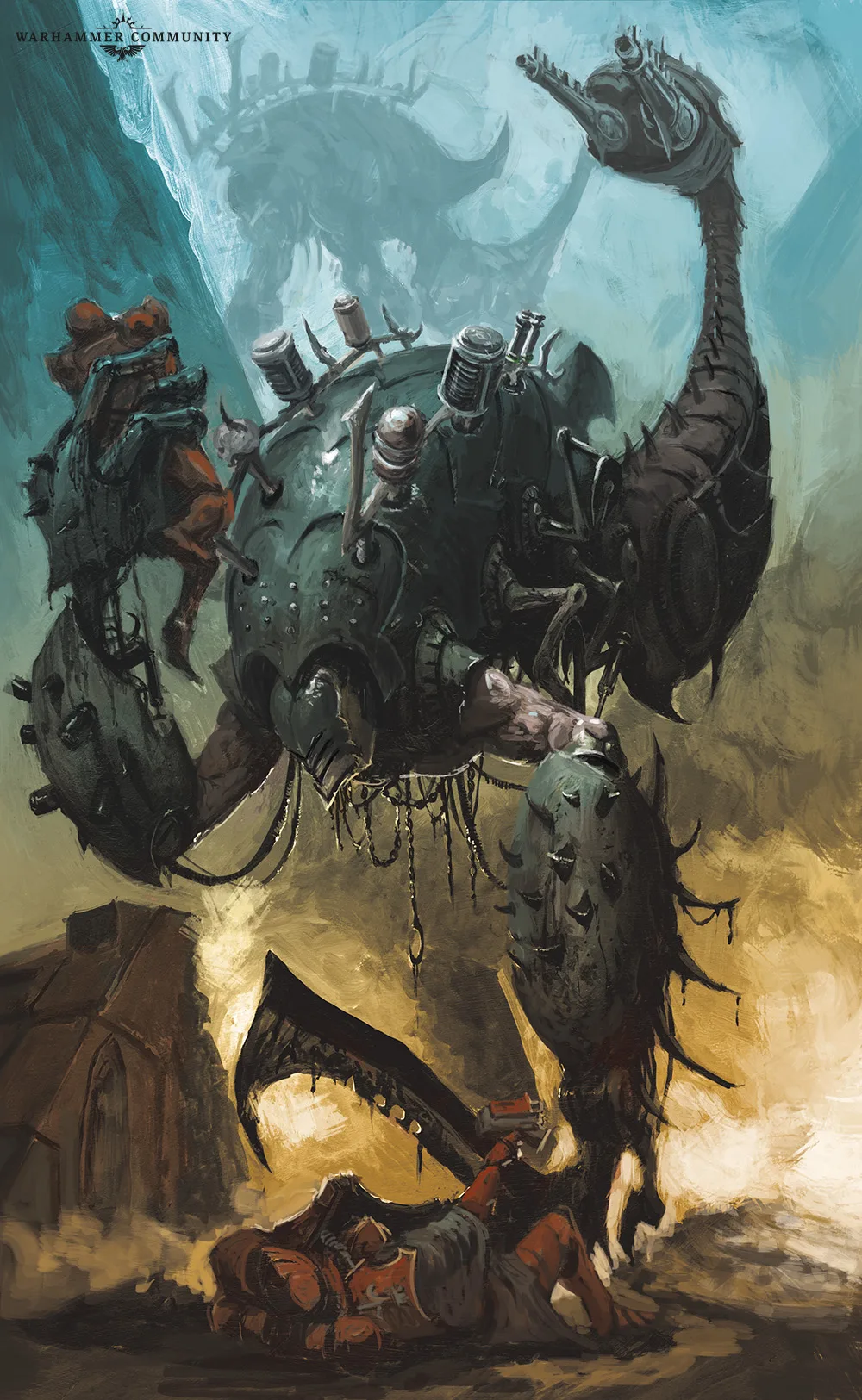
| Wracks / Grotesques | Coven | Durable infantry / brutes | Surgically altered servants; Grotesques are walls of stitched muscle |
| Talos / Cronos | Coven | Pain Engines | Talos: melee monster. Cronos: drains souls to heal allies |
| Incubi | Independent | Elite bodyguards | Klaives; sworn to no Kabal, hired by all |
| Mandrakes | Independent | Shadow infiltrators | Emerge from darkness; from the Aelindrach sub-realm |
Named characters: Asdrubael Vect (Supreme Overlord), Lelith Hesperax (Cult of Strife), Urien Rakarth (Prophets of Flesh), Drazhar (Master of Blades, Incubi), Lady Malys (Kabal of the Poisoned Tongue, Vect's eternal rival).
How they compare with the other Aeldari kindreds, and with the Imperium's forces, is in the complete 40k factions guide; the Craftworlders they despise are covered in the Aeldari guide, and the god they feed to avoid in the Slaanesh guide.
The Psychology of the Damned
To live among the Drukhari is to inhabit a world without trust. In a society where suffering is currency and immortality is bought with betrayal, every alliance is a transaction awaiting its inevitable collapse, and to trust is to bare one's throat. They are absolute hedonists, pursuing sensation, beauty and cruelty with the focus of true artists, for an existence stretched across millennia demands ever-sharper pleasures to feel anything at all. Their elegance and their savagery are inseparable; a Drukhari can compose a symphony and orchestrate a massacre with the same refined delight.
And here lies the great tragedy and horror of the Aeldari race. The Drukhari and the Craftworlders are the same people, faced with the same curse, who chose opposite answers. One kindred turned inward, embracing sorrow and iron discipline to deny Slaanesh His prize; the other turned outward, embracing appetite and atrocity to feed the curse with the lives of others. The mournful spires of the craftworlds and the screaming arenas of Commorragh are two reflections of a single broken soul. Where the Aeldari grieve for what they were, the Drukhari simply refuse to stop being it.
Frequently Asked Questions
Are Drukhari and Dark Eldar the same?
Yes. "Drukhari" is the modern in-universe term for the faction long known as the "Dark Eldar". The rename reflects the broader shift away from the word "Eldar" toward "Aeldari" across the setting. Nothing essential about the faction changed — they remain the webway-dwelling raiders and slavers of old; only the name has been updated.
What is Commorragh?
Commorragh is the Dark City, the vast hidden capital of the Drukhari, buried deep within the webway beyond the reach of time and concealed from the gaze of Slaanesh. It is a labyrinthine sprawl of spires, arenas and pleasure-palaces from which the Drukhari launch their raids into realspace and to which they drag their captives. It is effectively unconquerable, for no enemy can find it.
Why are the Drukhari so cruel?
Their cruelty is survival. Like all Aeldari, their souls are slowly devoured by Slaanesh. The Drukhari hold this hunger at bay by feeding on the agony and suffering of others — inflicting pain literally rejuvenates them and restores their vitality. Without a steady harvest of anguish, they wither and age. Their sadism is therefore not mere vice but the metabolic foundation of their immortality.
How are Drukhari different from Craftworld Aeldari?
They are the same race answering the same curse in opposite ways. The Craftworlders deny Slaanesh through austerity, discipline and the rigid Path, caging their souls and mourning the empire they lost. The Drukhari indulge every appetite and feed the curse with the suffering of others. One kindred is disciplined and sorrowful; the other is hedonistic and cruel. They are, in essence, two halves of one shattered people.
Why aren't the Drukhari corrupted by Chaos?
Although Slaanesh hungers for them and they wallow in excess, the Drukhari are not worshippers of Chaos and resist its corruption. Commorragh's position within the webway hides them from the Chaos Gods, and their feeding on pain is a deliberate strategy to starve Slaanesh, not serve Him. They sustain themselves against the warp's predation rather than surrendering to it — a defiance, in their own twisted fashion.
Where do the Drukhari get their captives?
From their raids. Drukhari strike realspace targets without warning, seize prisoners by the thousand, and vanish back into the webway. The captives are taken to Commorragh to fight in the arenas, to be reshaped by the Haemonculus Covens, or simply to be kept as slaves whose ongoing suffering nourishes their masters.
What is a Kabal in Warhammer 40k?
A Kabal is a Drukhari power bloc — part noble house, part army, part corporation — ruled by an Archon. Kabals control the fleets and most of the soldiers of Commorragh; the Kabal of the Black Heart, under Asdrubael Vect, has dominated the Dark City for thousands of years.
What is a Wych Cult?
Gladiatorial societies led by a Succubus. Wyches fight unarmoured in Commorragh's arenas and on the battlefield, relying on speed and combat drugs. The Cult of Strife, led by Lelith Hesperax, is the most famous.
What does a Haemonculus do?
Haemonculi are the flesh-sculptors of the Covens: surgeons, torturers and the only Drukhari who can restore the dead to life. Archons pay them for resurrection insurance; the Covens pay themselves in the pain their experiments produce.
Who is Asdrubael Vect?
The Supreme Overlord of Commorragh, Archon of the Kabal of the Black Heart and the most powerful Drukhari alive. Born a slave, he engineered the fall of the old noble houses and has ruled the Dark City ever since, surviving countless assassination attempts.
Continue Exploring
- Warhammer 40,000 Factions: The Complete Guide — see where the Drukhari sit among the galaxy's powers.
- Aeldari / Craftworld Eldar Lore Guide — meet the sorrowful kin who chose the opposite path.
- Slaanesh, the Dark Prince — the god who hungers for every Aeldari soul.
- The Chaos Gods — the ruinous powers that haunt the setting.
- Space Marines — the Imperium's finest, and frequent victims of Drukhari raids.
- Name generator — conjure suitably cruel and elegant names for your own dark raiders.
- For deeper canon, consult Lexicanum.
The Drukhari prove that damnation can wear a beautiful face — that immortality, bought with the suffering of others, is the cruellest kind of art. If their decadent, treacherous world has sparked something in your imagination, why not build a realm of your own? Create a free Anima account and start crafting the cities, cultures and dark mirrors of your own setting — every screaming arena and hidden labyrinth waiting to be written.
Keep reading
More from this topic
Necrons: Warhammer 40K Lore Guide
The complete lore of the Necrons — the doomed Necrontyr, the C’tan star-gods, biotransference, the War in Heaven, and the deathless dynasties now waking to reclaim the galaxy.
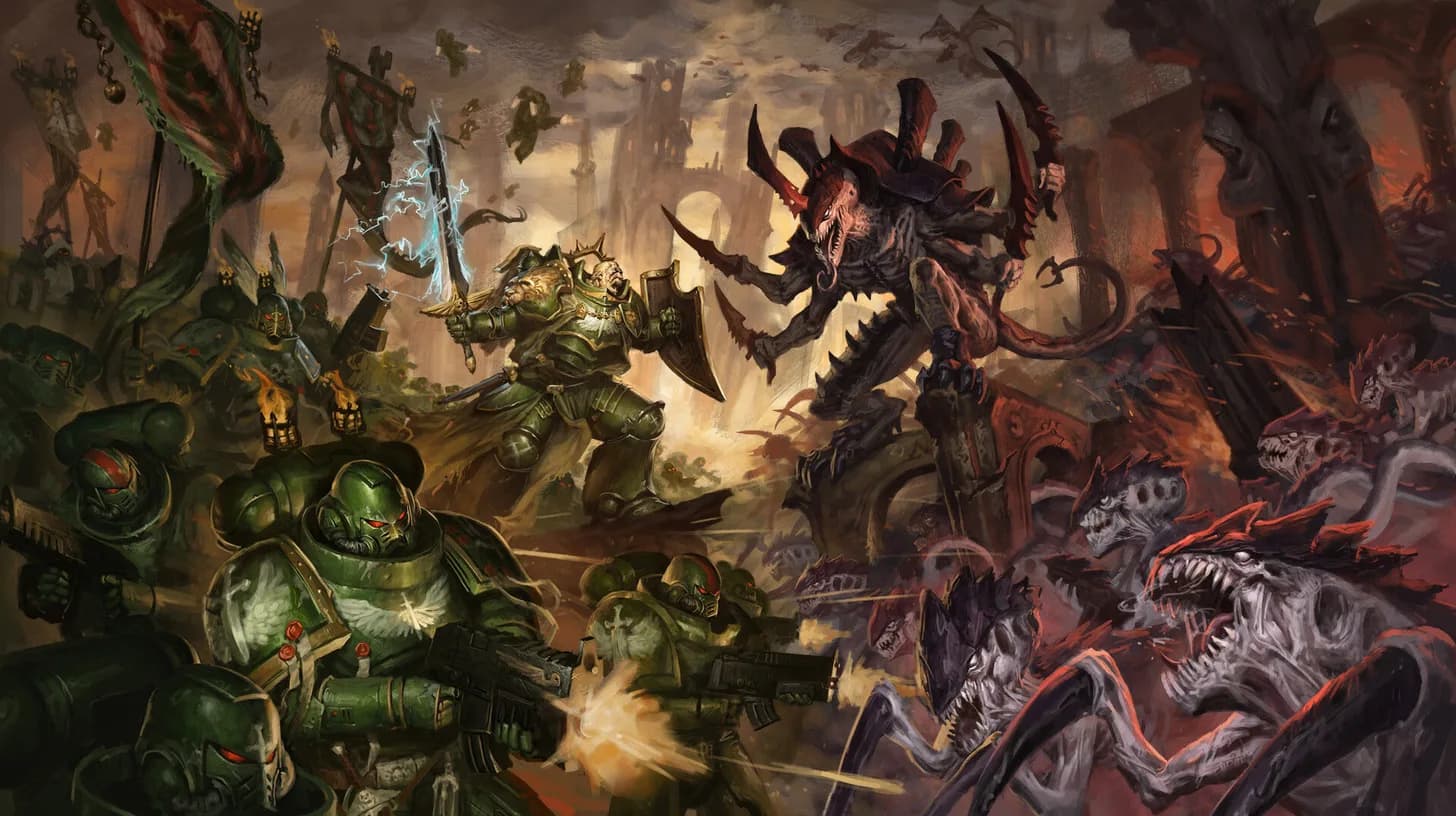
Tyranids: Warhammer 40K Lore Guide
The complete lore of the Tyranids — the Great Devourer, the Hive Mind, the Shadow in the Warp, the great Hive Fleets, Genestealer Cults, and the hunger that crossed the void between galaxies.
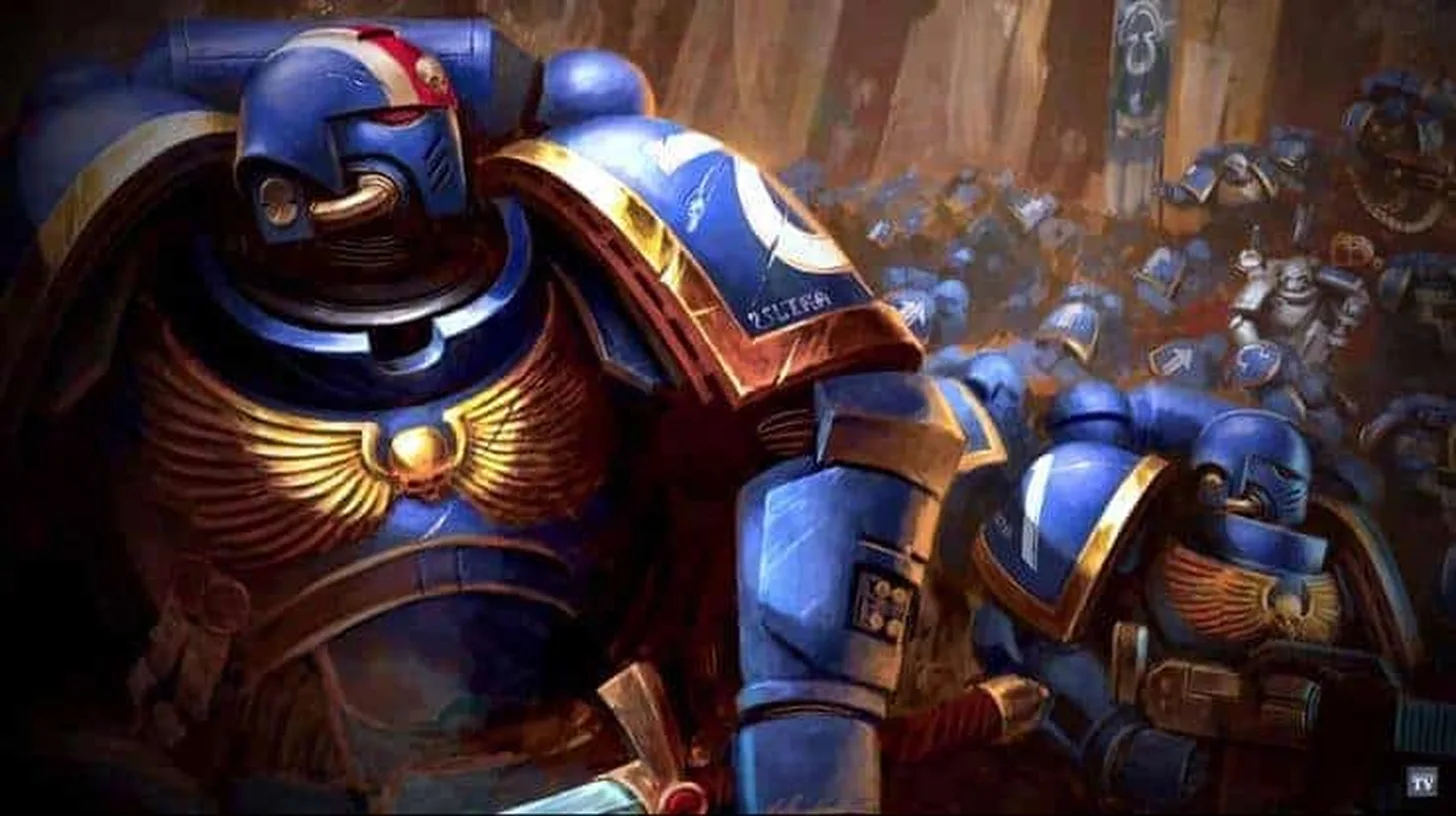
Space Marines (Adeptus Astartes): Warhammer 40K Lore Guide
The complete lore of the Space Marines — the Primarchs, gene-seed, the Horus Heresy, the Codex Astartes and the Chapters, the Primaris and Guilliman’s return, and the cost of the Angels of Death.
Start building your world today
Maps, wikis, timelines, and AI tools — everything you need to bring your world to life, in one place.