Necrons: Warhammer 40K Lore Guide
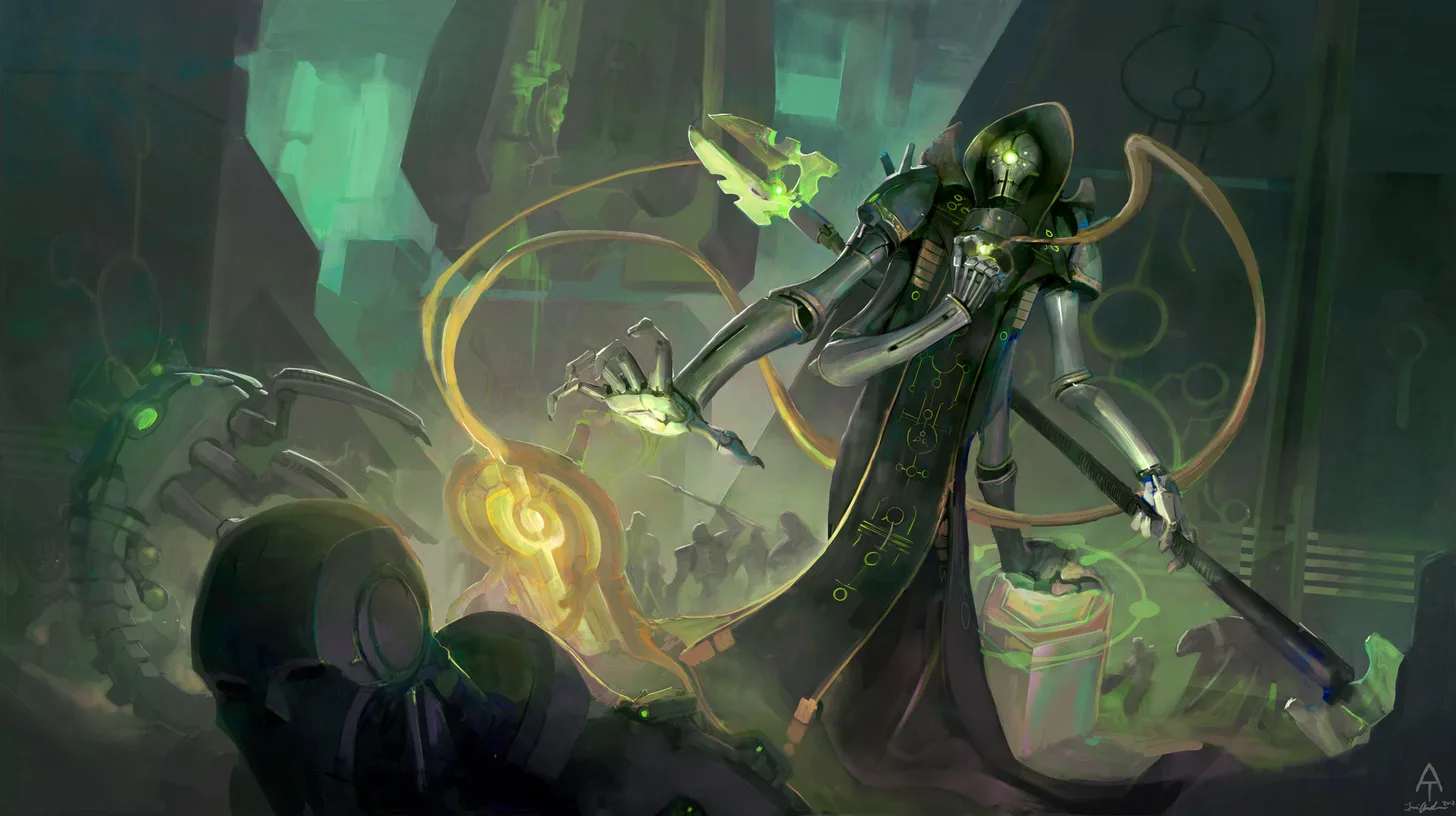
In the deepest reaches of the galaxy, beneath the dust of dead worlds, something ancient stirs. Stone sarcophagi grind open. Eyes the colour of cold flame ignite in the dark. Legions of skeletal warriors, forged from living metal and powered by technologies older than the stars mortals worship, rise in silence after sixty million years of slumber. These are the Necrons — and they have come to reclaim a galaxy they once ruled before humanity's ancestors had learnt to walk upright. They do not hunger. They do not breed. They simply remember what was theirs, and they intend to take it back.
This guide explores the full tragic arc of the Necrons: the doomed mortal race that became them, the malevolent star-gods who damned them, the cataclysmic Warhammer 40,000 war that shaped the entire setting, and the cold, calculating dynasties that now awaken across the stars. Whether you are a lore newcomer, a worldbuilder hunting inspiration, or a tabletop player wanting the story behind the metal, this is the definitive narrative tour of the galaxy's most ancient power — a civilisation that achieved immortality and lost everything that made it worth having.
Necrons at a Glance
| Aspect | Detail |
|---|---|
| Origin | The Necrontyr, a short-lived mortal race obsessed with death and dynasty |
| Nature | Immortal sentient minds housed in self-repairing living-metal (necrodermis) bodies |
| Homeworlds | Countless Tomb Worlds across the galaxy, ruled by individual dynasties |
| Leadership | The Silent King (Szarekh), Phaerons, Overlords and Crypteks; once the Triarch |
| Defining Trait | Cold immortality — they traded flesh and soul for survival |
| Greatest Enemy | Historically the Old Ones and the C'tan; today, all who hold their lost dominion |
| Age | Over 60 million years; the oldest active power in the galaxy |
| Weakness | Degraded protocols, fractured memories, and ambition turned against itself |
The Necrontyr: A Race Born to Die
Long before the Imperium of Man, before even the rise of the elder races, there lived the Necrontyr. They evolved beneath a baleful, radiation-soaked star on a harsh homeworld, and the price of that bitter cradle was a curse woven into their very biology: their lives were short, brutal and racked by disease and decay. A Necrontyr might live only a handful of years before withering away. Death was their constant companion, and so it became the centre of their entire culture.
The Necrontyr built a civilisation obsessed with mortality. They raised colossal tomb-monuments to their dead, practised elaborate funerary rites, and organised themselves into a rigid hierarchy of noble dynasties. Over this fractious empire ruled the Triarch — a triumvirate of authority crowned by a single absolute monarch, the Silent King. Yet for all their grandeur, the Necrontyr nursed a venomous resentment. As they ventured into the stars, they encountered species blessed with the one thing they could never possess: long, vigorous, near-immortal life. That envy curdled into hatred, and hatred into a hunger for conquest that would set the stage for catastrophe.
The C'tan: The Star Gods Awaken
In their desperate quest to escape death, the Necrontyr scoured the galaxy and discovered something extraordinary dwelling within the hearts of stars — vast, formless beings of pure living energy. These were the C'tan, the Star Gods. In their natural state they were diffuse, slow, and barely aware, feeding on the raw radiation of suns across uncounted aeons.
The cunning Necrontyr did not flee from these entities. Instead, they captured fragments of their essence and forged bodies of living metal to contain them — necrodermis shells that gave the C'tan form, focus and a terrible new appetite. Once embodied, the Star Gods grew swift and monstrously powerful, and they developed personalities as cruel as they were brilliant. Among them rose figures of legend: Aza'gorod the Nightbringer, an avatar of death itself whose very shape seeded the fear of mortality into countless species across the galaxy, and Mephet'ran the Deceiver, a master of lies and manipulation whose schemes would prove the Necrontyr's undoing. The mortals believed they had found gods to serve them. In truth, they had unleashed predators.
Biotransference: The Bargain That Damned a Race
The C'tan, ever hungry, recognised in the Necrontyr a feast beyond imagining — and a tool. The Deceiver and his kin offered the dying race a gift wrapped in their deepest desire: immortality. Through a process called biotransference, the Necrontyr would shed their frail, disease-ridden flesh and pour their minds into bodies of indestructible living metal, identical to the C'tan's own shells. No more sickness. No more death. Eternal life at last.
The Necrontyr accepted. It was the worst decision any species has ever made. As their consciousnesses flowed into the cold metal, the C'tan feasted upon the energy and substance of their souls. The transference stripped away their flesh — and with it, for the overwhelming majority, the bulk of their sentience, their emotion, their very selves. Entire dynasties of feeling, dreaming people were reduced to soulless automatons, mindless metal soldiers awaiting orders. Only the strongest-willed nobles retained anything resembling a personality. The race that had so feared death had instead become a nation of the walking dead, their souls devoured to fuel the gods they had served. The Necrontyr were no more. In their place stood the Necrons.
The War in Heaven
Now an immortal, tireless army enslaved to the will of the Star Gods, the Necrons were turned against the dominant powers of the young galaxy: the Old Ones. These were an ancient, benevolent reptilian race of unmatched mastery over the Warp and the strands of life itself — the great architects of the galaxy, creators of the webway and shapers of countless species. The conflict that followed is remembered as the War in Heaven, a war so vast and so terrible that its scars still define the setting of the forty-first millennium.
Unable to match the Necrons' tireless metal legions directly, the Old Ones engineered new warrior-species to fight on their behalf. From their genius came the precursors of the Aeldari — the psychically gifted ancestors of the Eldar — and the brutal, fungal Krork, the towering forebears of the Orks, bred purely for slaughter. For millions of years the galaxy burned. The C'tan grew bloated and arrogant on the carnage, devouring star systems and warring even amongst themselves. And it was in the ashes of this conflict, as the surviving races bled, that the Necrons finally saw their chance for freedom.
The Rebellion and the Shattering of the Gods
The Necron nobles who had kept their minds never forgot what the C'tan had stolen from them. They had watched their entire species — their families, their culture, their souls — consumed to feed the gluttony of their so-called gods. As the War in Heaven ground towards its end and the C'tan turned upon one another in their endless greed, the Silent King reached a fateful decision: the Necrons would destroy their masters.
Using technologies refined over the long war, the Necrons turned on the Star Gods and shattered them. Each C'tan was broken into countless shards — fragments of the original entity, each a diminished but still dangerous splinter of godhood. These shards were imprisoned within special tesseract vaults and pocket dimensions, kept as weapons and slaves of the Necrons rather than their masters. The hunters had become the hunted. Yet victory came too late and at too high a price. The Necrontyr were extinct in all but name, the galaxy was ravaged, and the surviving servants of the Old Ones — the nascent Aeldari above all — were ascendant. There was nothing left to rule.
The Great Sleep and the Awakening
Exhausted, soul-sick, and with their empire in ruins, the Necrons made their final retreat. The Silent King ordered the entire race into the Great Sleep — a vast hibernation within stasis-crypts buried deep inside their Tomb Worlds. There they would slumber for sixty million years, waiting for the galaxy to heal, for their living-metal bodies to repair the damage of war, and for the younger races to exhaust themselves so that the Necrons might rise unopposed and rebuild their dominion.
Damaged Protocols
But sixty million years is a long time, even for the deathless. The Great Sleep did not go to plan. Tomb Worlds suffered geological cataclysms, stellar collisions, and the slow entropy of their own systems. When the awakening finally began in the late forty-first millennium, many dynasties rose with their reanimation protocols corrupted. Some Necrons emerged with shattered memories, their grand strategic minds reduced to looping fragments. Some Tomb Worlds awoke as nightmarish realms where the inhabitants, driven mad by aeons of degradation, hunt the living to harvest flesh in a doomed attempt to recreate the bodies they lost. Others awoke pristine, their lords as cold, brilliant and ambitious as the day they entered slumber. This unevenness is the engine of much Necron drama — a galaxy-spanning empire reawakening piece by piece, some shards lucid and patient, others broken and ravenous.
The Silent King, the Dynasties, and Their Lords
The Necrons are not a monolithic empire but a tapestry of dynasties, each ruled by a Phaeron or Overlord and each with its own character, grudges and ambitions. Above them all looms the figure of the Silent King — Szarekh, the last ruler of the old Triarch. Wracked by guilt for the doom he brought upon his people through biotransference, he exiled himself beyond the galaxy after the rebellion. He has since returned, having glimpsed a new threat devouring everything in its path, and now seeks to unite the fractured dynasties once more.
The Great Dynasties
- Sautekh — the most aggressive and ascendant dynasty, led by Imotekh the Stormlord, a peerless strategist who commands the very weather of worlds and pursues outright conquest of the galaxy.
- Nihilakh — fiercely territorial isolationists obsessed with reclaiming exactly what was theirs and not one star more, guarding their hoarded treasures with paranoid zeal.
- Mephrit — sun-worshippers and expansionists who employ devastating solar-powered weaponry and believe all lesser species exist only to be ground beneath them.
- Novokh — the "blood-drinkers", a martial dynasty that has revived the ancient war-rituals of the Necrontyr, painting their living metal red and revelling in close-quarters slaughter.
Legendary Individuals
Some Necron lords are characters of genuine depth and dark humour. Trazyn the Infinite is the galaxy's greatest and most eccentric collector, a magpie archaeologist who steals priceless artefacts, historical figures and entire battles frozen in stasis to fill his endless galleries — often substituting decoy bodies for himself so that he can never truly be destroyed. Orikan the Diviner is a master astromancer who reads the future in the movements of the stars and manipulates time itself to engineer destinies. Anrakyr the Traveller roams the galaxy as a self-appointed crusader, seeking to rouse dormant Tomb Worlds and reunite the Necron race — by persuasion where possible, and by force where not. And then there is the sinister Szeras, a cryptek of monstrous experimentation whose obsessions point towards one of the Necrons' most haunting ambitions.
Technology, Themes, and the Necron Tragedy
Necron technology operates on principles that border on the magical even by the standards of the forty-first millennium. Their soldiers are bound by reanimation protocols — when a Necron warrior is struck down, its living-metal body knits itself back together and the construct simply stands and resumes the advance, making them maddeningly difficult to truly destroy. Their armaments are equally fearsome: gauss weapons that flay matter molecule by molecule, stripping armour, flesh and bone into nothing, and tesla weapons that arc living lightning between targets. Necron forces phase across battlefields with teleportation technology, deploy from hidden dimensional pockets, and travel between worlds via dolmen gates, which allow them to brute-force their way into the Aeldari webway — the great trans-dimensional network the Old Ones built.
Yet beneath the cold gleam of necrodermis lies one of the most tragic stories in all of science fiction. The Necrons are the ultimate cautionary tale: a people so terrified of death that they surrendered everything that made life worth living to escape it. They achieved immortality and lost their souls in the bargain. The contrast between the lucid, scheming lords who remember their lost humanity and the silent, mindless warrior-masses they command is a constant, quiet horror. An Overlord may rule an empire spanning a thousand worlds, and yet every soldier in his legions is a hollowed-out friend, a brother, a child whose mind was eaten so that the lord might live forever. Immortality, for the Necrons, is not a triumph. It is a sentence.
The Goals of the Awakened
Most Necrons share a single overriding purpose: to reclaim their ancient empire and reassert their rightful dominion over a galaxy they ruled before all others. Some pursue total conquest; others, mere restoration of old borders. But a darker, more poignant ambition runs through certain dynasties. Through the experiments of crypteks like Szeras, some Necrons seek the impossible — to reverse biotransference and restore living, biological flesh to their metal frames. They wish to feel sunlight again, to taste, to dream, to be alive. It is a yearning that drives some Necrons to harvest the bodies and souls of the living in horrifying numbers, chasing a redemption that may forever be beyond their grasp.
Necrons FAQ
Are Necrons just robots?
No — and this is the crux of their tragedy. Necrons are not artificial intelligences or simple machines. Each one is a once-living Necrontyr whose mind and soul were forcibly transferred into a living-metal body during biotransference. The metal frame is a vessel for a real consciousness, even if, for most warriors, the transference reduced that consciousness to a husk. They are better understood as cybernetic undead than as robots.
Are Necrons evil?
It depends entirely on the dynasty. Necron morality ranges from coldly pragmatic to genuinely monstrous. Some lords are arrogant and ruthless but bound by ancient codes of honour, regarding lesser species with lordly disdain rather than active malice. Others are utterly genocidal. Crucially, the Necrons see themselves not as villains but as the galaxy's rightful and most ancient rulers, reclaiming what was unjustly taken from them. They are antagonists of perspective rather than cartoon evil — which makes them far more compelling.
What happened to the C'tan?
After the War in Heaven, the Necrons rebelled against their gods and shattered each C'tan into countless fragments known as shards. These shards are now imprisoned and enslaved by the Necrons, deployed as living weapons of terrible power but kept firmly under control. No whole, original C'tan is known to remain free — though Necron lords live in quiet dread that one might one day reassemble itself. For more on how their soulless nature makes them uniquely immune to other galactic horrors, see how the Chaos Gods cannot touch them: because biotransference stripped the Necrons of their souls, they cast no shadow in the Warp and cannot be corrupted, possessed or consumed by Chaos. They are one of the only forces in the galaxy that the Dark Gods cannot reach.
Can Necrons feel emotion?
The ruling nobility — Phaerons, Overlords, crypteks and named characters — retained their full personalities through biotransference and absolutely feel emotion: ambition, pride, vengefulness, grief, even humour, as Trazyn the Infinite's eccentric obsessions demonstrate. The vast warrior-masses, however, were almost entirely hollowed out, retaining only enough awareness to follow orders. This spectrum, from richly characterful lords to soulless soldier-husks, is central to their identity. According to background material catalogued by sources such as Lexicanum, even some degraded Necrons display flickers of their lost selves, which only deepens the horror.
How do Necrons reproduce?
They do not. Necrons are immortal and entirely sterile — there are no new Necrons. Their numbers are fixed at whatever survived the Great Sleep, supplemented only by self-repair and the rebuilding of damaged units. This makes every Necron irreplaceable and lends a grim finality to their wars: they cannot breed replacements, only awaken more of the dormant dead or repair the fallen. It also fuels the desperate experiments of those who dream of restoring biological flesh.
How do Necrons compare to the other great threats?
The Necrons are the galaxy's most ancient power, but they are far from its only menace. They war constantly against the Space Marines and the wider Imperium that now squats upon their old territories, and they regard the all-consuming Tyranids as an existential threat — indeed, it is partly the Tyranid menace that has drawn the Silent King back to unite his people. Where the Tyranids devour and the Imperium endures, the Necrons simply wait, patient and deathless, certain that eternity favours those who cannot die.
Continue Exploring
The Necrons are one thread in the vast tapestry of the forty-first millennium. To understand the galaxy that hates and fears them, follow these guides:
- The Complete Warhammer 40,000 Factions Guide — the umbrella overview of every major power in the galaxy.
- The Aeldari (Craftworld Eldar) Lore Guide — the ancient enemies forged by the Old Ones during the War in Heaven.
- The Orks Lore Guide — descendants of the brutal Krork, bred to fight the Necrons.
- The Tyranids Lore Guide — the devouring swarm that even the deathless Necrons fear.
- The Space Marines Lore Guide — the Imperium's superhuman warriors who fight to hold the worlds the Necrons would reclaim.
- The Chaos Gods Guide — the Warp powers the soulless Necrons alone can resist.
- NPC Generator — breathe life into the lords, crypteks and awakened characters of your own setting.
Inspired to build a galaxy of your own — whether a deathless undead empire, a sprawling sci-fi dynasty, or an entirely new fantasy world? Create a free Anima account and start crafting your own worlds, factions and campaigns today. Every great mythos begins with a single tomb world waiting to wake.
Keep reading
More from this topic
Space Marines (Adeptus Astartes): Warhammer 40K Lore Guide
The complete lore of the Space Marines — the Primarchs, gene-seed, the Horus Heresy, the Codex Astartes and the Chapters, the Primaris and Guilliman’s return, and the cost of the Angels of Death.
Tyranids: Warhammer 40K Lore Guide
The complete lore of the Tyranids — the Great Devourer, the Hive Mind, the Shadow in the Warp, the great Hive Fleets, Genestealer Cults, and the hunger that crossed the void between galaxies.
Slaanesh: The Dark Prince — Complete Warhammer Guide
Everything about Slaanesh, the Chaos God of excess, pleasure, pain, and perfection. Lore, daemons, Emperor's Children, the Palace of Pleasure, and why the Prince of Chaos is the most insidious of the Dark Gods.
Start building your world today
Maps, wikis, timelines, and AI tools — everything you need to bring your world to life, in one place.