Sanguinius: Warhammer 40K Lore Guide
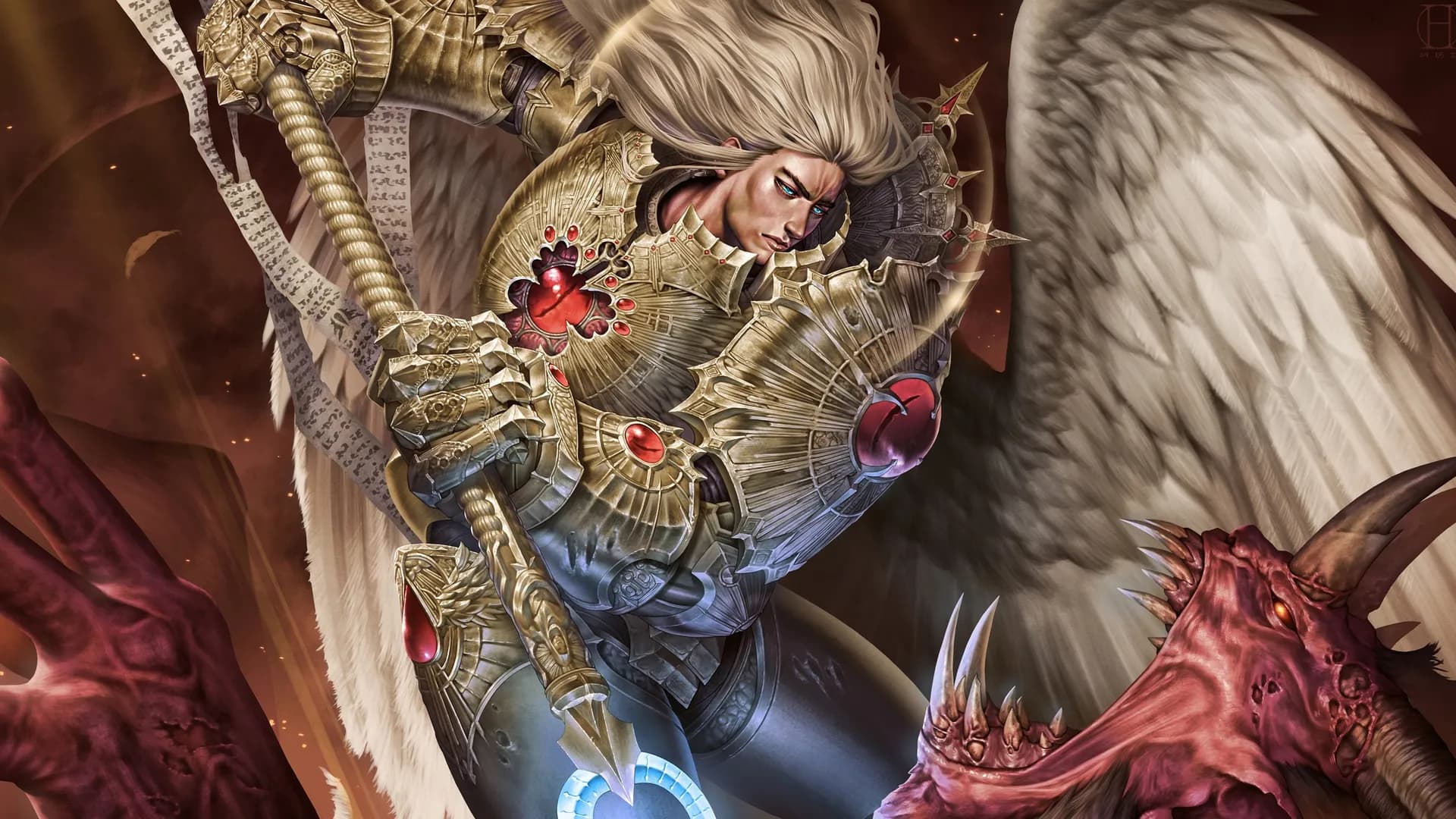
Of all the Emperor's twenty sons, Sanguinius is the one the Imperium mourns most. Golden-haired, white-winged and gifted with foresight, the Great Angel was the Primarch of the Blood Angels, and many of his brothers considered him the finest of them all. Ten thousand years after his death, his face is carved into cathedrals, his sons still dream his final moments, and the faithful of the Imperial Cult revere him as one of the Emperor's most exalted sons.
His story is a short one by the standards of a demigod: a childhood on a poisoned moon, a few glorious decades of the Great Crusade, a Legion's secret curse, and a death he saw coming long before it arrived. This guide looks past the Chapter he left behind and focuses on the Angel himself — his origins on Baal, his campaigns in the Horus Heresy, his relationships with Horus, Dorn and Guilliman, the duel aboard the Vengeful Spirit, and the legacy that still shapes the Sons of Sanguinius in the 42nd millennium.
Sanguinius at a Glance
| Aspect | Detail |
|---|---|
| Titles | The Great Angel, the Angel of Baal, Lord of the IX Legion |
| Primarch number | IX |
| Legion | Blood Angels |
| Allegiance | Loyalist |
| Homeworld | Baal Secundus, a radioactive moon of Baal |
| Signature wargear | The Blade Encarmine and the Spear of Telesto |
| Fate | Slain by Horus aboard the Vengeful Spirit at the end of the Siege of Terra |
| Status in M42 | Dead; venerated as a saint-like figure, his memory alive in the Black Rage |
Origins: The Angel of Baal Secundus
Like every one of the Primarchs, Sanguinius was torn from the Emperor's gene-laboratories on Terra as an infant and cast across the galaxy by the Ruinous Powers. His capsule came down on Baal Secundus, one of the two moons orbiting the world of Baal. Ancient wars had poisoned it with radiation, and the human tribes that survived there were stalked by monstrous mutants.
The child who emerged was unlike any of his brothers. He was born with great feathered wings — the only Primarch with so visible a mark of difference — and on a world plagued by mutation, that alone set him apart. Sanguinius matured at a terrifying pace, and while still a youth he led the surviving tribes against the mutant hordes, uniting the survivors under his protection. By the time the Emperor arrived, Baal's people already worshipped him as an angel.
The Emperor gave him command of the IX Legion, whose warriors adopted Baal as their recruiting world and took the name Blood Angels. Sanguinius reshaped them in his image: warriors who valued art, history and beauty as much as killing, and who tried to be noble rather than merely effective. He carried a second gift that few of his brothers shared to the same degree — prophetic visions. Several sources state that he foresaw his own death long before the Heresy began, and chose to walk toward it anyway.
The Great Crusade and the Hidden Flaw
During the Great Crusade, Sanguinius was one of the most admired of the Primarchs. He fought alongside Horus on many campaigns, and the two became so close that Horus is often described as trusting the Angel above all his other brothers. When the Emperor named Horus Warmaster after the Ullanor campaign, Sanguinius was among his staunchest supporters.
Behind the glory lay a secret. The Blood Angels' gene-seed carried a flaw that gave some warriors an unnatural hunger for blood and, at worst, drove them into feral frenzy. Black Library's Horus Heresy novels describe Sanguinius hiding the extent of the problem from his brothers and from the Emperor, while his Apothecaries searched for a cure. Some versions suggest the Emperor knew more than he admitted. Either way, the Legion's honor depended on the flaw remaining hidden.
Signus Prime and the Horus Heresy
When Horus turned traitor, he made sure his most dangerous loyal brother was far from the fighting. In James Swallow's Fear to Tread, Horus sends the Blood Angels to the Signus Cluster on a false mission. The system is a trap, saturated with daemonic energy, and the Legion is set upon by the Bloodthirster Ka'Bandha, a Greater Daemon of Khorne. The daemon's purpose is to wake the Blood Angels' hidden thirst and turn them into servants of the Blood God.
Many Blood Angels did succumb, and the Legion came close to breaking. Sanguinius defeated Ka'Bandha, but the scars of Signus Prime never fully healed. It was the first time the curse, later called the Red Thirst and the Black Rage, became impossible to hide.
Cut off from Terra by warp storms, the Blood Angels eventually reached Ultramar. There, in Dan Abnett's The Unremembered Empire, Roboute Guilliman had founded Imperium Secundus, a contingency realm built in case Terra had already fallen. Guilliman proposed that Sanguinius rule it as its emperor. The Angel accepted the role with visible reluctance, and the arrangement collapsed once it became clear the Emperor still lived. It remains one of the strangest episodes in his story: the most loyal of sons, briefly crowned in his father's absence.
The Siege of Terra
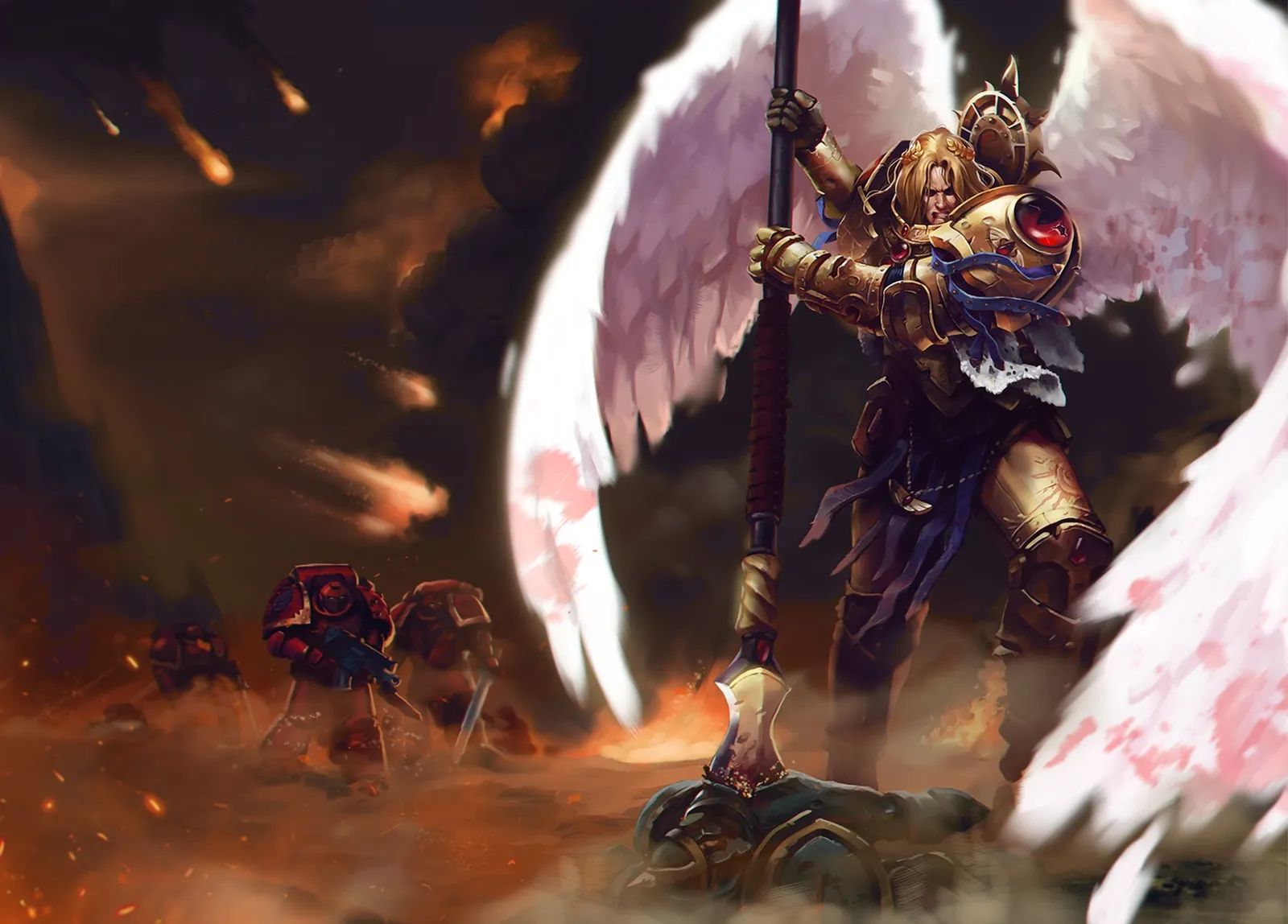
The Blood Angels returned to Terra in time for the final act of the Horus Heresy. During the Siege, Sanguinius commanded the defense of the Imperial Palace beside Rogal Dorn and the Adeptus Custodes, and became the symbol that kept exhausted soldiers on the walls.
His most famous stand came at the Eternity Gate, the last great entrance to the Sanctum Imperialis. There he fought Ka'Bandha once more, and long-standing lore holds that he broke the Bloodthirster and hurled it from the walls, though he was badly wounded. The Siege of Terra novels, especially Aaron Dembski-Bowden's Echoes of Eternity, dwell on this last defense: the Angel holding a doorway against an impossible tide, knowing what still waited for him.
Death Aboard the Vengeful Spirit
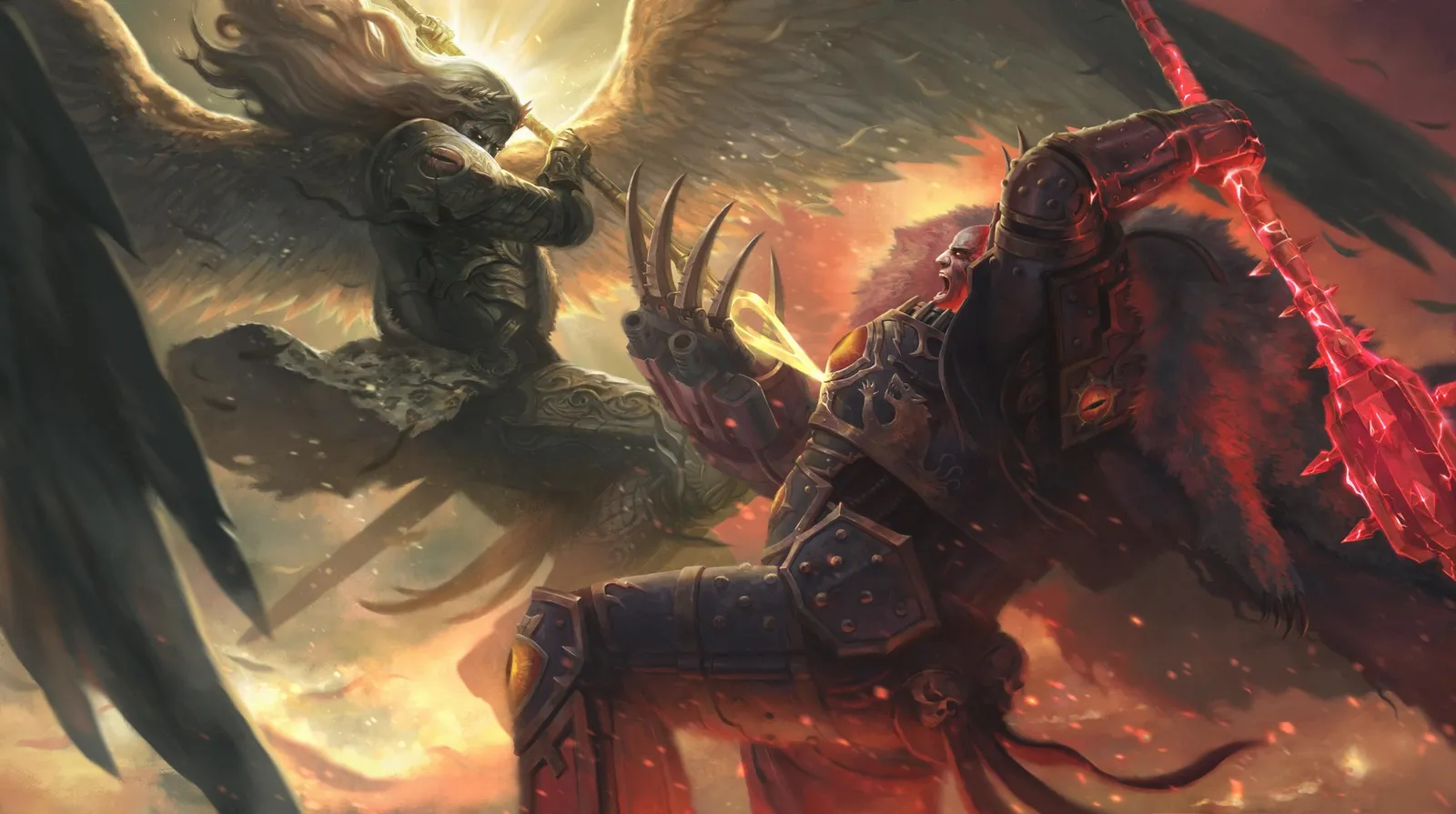
When the Palace was on the verge of falling, Horus lowered the void shields of his flagship, the Vengeful Spirit. The Emperor recognized the challenge and teleported aboard with His closest companions, Sanguinius and Rogal Dorn among them. The warp-touched ship scattered them across its decks, and the Angel was the first to reach the Warmaster.
Accounts agree on the outline. Horus offered his favored brother a place at his side. Sanguinius refused, though his visions had already told him how the fight would end. He fought anyway, alone, and was killed. Many versions add that he dealt Horus a wound before he fell, a flaw in the Warmaster's armor that the Emperor would later exploit. When the Emperor arrived, He found His son's broken body at Horus's feet.
Sanguinius died in psychic agony, and that moment did not end with him. It imprinted itself on the gene-seed of his Legion. Ever since, Blood Angels and their successors can fall into the Black Rage, reliving the Angel's final battle as if they were Sanguinius himself. The Death Company exists because of what happened in that throne room.
Personality and Relationships
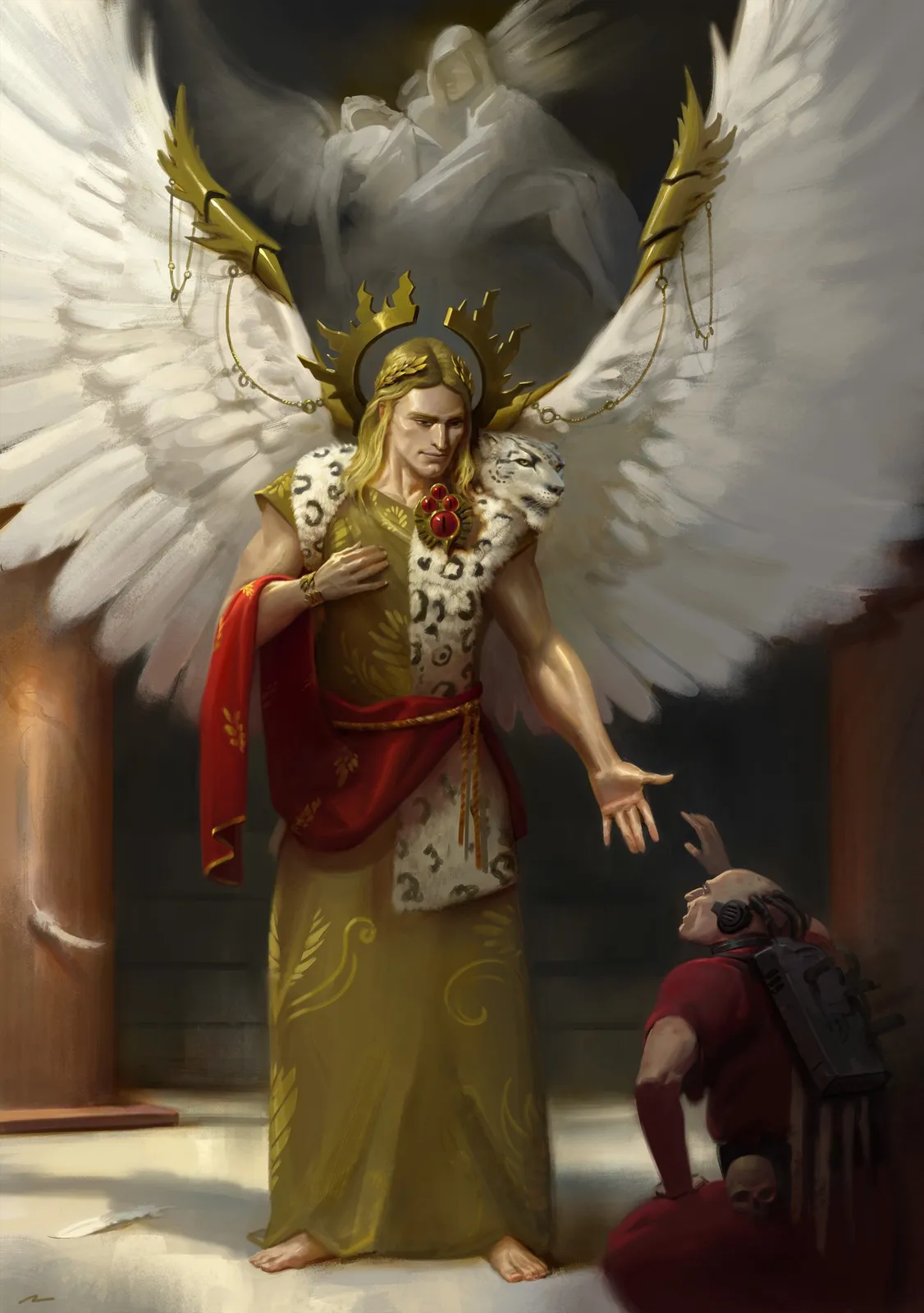
Sanguinius is usually written as the most balanced of the Primarchs: charismatic without arrogance, gentle without weakness, and deeply aware of his own Legion's darkness. That self-knowledge is what makes him tragic rather than simply heroic. He knew what his sons were and what he was going to face, and he never let either knowledge make him cruel.
- Horus Lupercal: his closest brother and eventual killer. Their bond is the emotional heart of the Heresy, and Horus's offer in the final duel was not entirely a trick — the Warmaster wanted Sanguinius beside him.
- Rogal Dorn: his companion on the walls of Terra. The two Primarchs held the Palace together, and Dorn was among the last to see the Angel alive.
- Roboute Guilliman: the brother who offered him an empire during the Imperium Secundus crisis. Their relationship was respectful, though Sanguinius never quite shared Guilliman's taste for contingency plans.
- Lion El'Jonson: also present at Imperium Secundus, where the old suspicions between the Primarchs surfaced. The Lion's return in the Great Rift era means he is now one of the few living brothers who remember the Angel personally.
- The Emperor: Sanguinius is often portrayed as the son closest in spirit to his father, and the Emperor of Mankind is said to have grieved him deeply.
Fate and Legacy in the 42nd Millennium
Sanguinius is dead, and unlike Guilliman or the Lion he has not returned. Yet his presence is everywhere among his sons. The Red Grail of the Sanguinary Priests is said to hold his blood. The golden death masks of the Sanguinary Guard bear his face. Commander Dante has led the Chapter for over a millennium while wearing his likeness. And the mysterious golden warrior called the Sanguinor, who appears only at moments of greatest need, is believed by some to be a fragment of the Angel's spirit, though the lore never confirms it.
The Black Rage is his darker legacy. Every successor Chapter, from the savage Flesh Tearers to the cursed Lamenters, carries the same memory, and the arrival of Primaris Marines did not free the bloodline from it. In the Great Rift era, the Imperial Cult venerates him more than ever, and Blood Angels Chaplains still teach that their father's death was a sacrifice, not a defeat. To see where his Chapter stands among the other armies of the setting, browse our Warhammer 40K factions guide.
Sanguinius on the Tabletop
Sanguinius is not a playable model in a standard Warhammer 40,000 army, because he died ten thousand years before the setting. He appears instead in Games Workshop's Horus Heresy game, where Forge World produced a resin miniature of the winged Primarch for Blood Angels Legion forces. That model is a centerpiece: a fast, devastating melee hero who leads from the front.
In Warhammer 40,000, his influence shows through the units that echo him: the Sanguinor, the golden Sanguinary Guard, Commander Dante, and the black-armored Death Company. Building a Blood Angels force is, in a sense, building an army around an absent father. If you are inventing your own Son of Sanguinius, the Space Marine name generator will help name him.
Sanguinius FAQ
How did Sanguinius die?
He was killed by Horus aboard the Vengeful Spirit at the end of the Siege of Terra. Sanguinius was the first to reach the Warmaster after the Emperor's party teleported aboard, refused Horus's offer to join him, and died in single combat. The Emperor arrived shortly after and destroyed Horus.
Why does Sanguinius have wings?
He was born with them. The lore treats the wings as part of his unique gene-craft rather than as a Chaos mutation, though it never fully explains them. They made him look like an angel to the people of Baal Secundus and gave his Legion its name and iconography.
Is Sanguinius coming back?
There is no sign of it. Unlike Guilliman, the Lion or the missing loyalist Primarchs, Sanguinius is confirmed dead. The Sanguinor is often linked to his spirit, but Games Workshop has deliberately left that mystery unresolved.
Did Sanguinius know he would die?
Yes. Sanguinius had powerful prophetic visions, and the lore repeatedly states that he foresaw his death at Horus's hands. He chose to face Horus anyway, which is why many Imperial sources treat his death as a willing sacrifice.
Who was the strongest Primarch, Sanguinius or Horus?
Horus won their duel, but he was empowered by all four Chaos Gods at the time. Among the Primarchs before the Heresy, Sanguinius and Horus were both regarded as among the most formidable, and fan debate about rankings has no official answer.
What is the connection between Sanguinius and the Black Rage?
The Black Rage is a psychic echo of his death. At the moment Sanguinius died, his agony imprinted itself on the gene-seed of his sons, so Blood Angels and their successors can be overwhelmed by visions of his final battle and believe they are the Angel himself.
Continue Exploring
- Blood Angels — the Chapter Sanguinius founded, its curse and its heroes
- The Primarchs — all twenty sons of the Emperor and their fates
- Horus Lupercal — the Warmaster who killed the Angel
- Rogal Dorn — the Praetorian who held Terra at his side
- The Horus Heresy — the civil war that ended his life
- Warhammer 40K Factions: Complete Guide to All 29 Armies — every army, its lore and how it plays
Browse every guide in the Warhammer 40K lore hub, or christen your own Sons of Sanguinius with the Space Marine name generator. To chronicle your own Chapter, Anima is free and runs in your browser with no account: a wiki, a timeline, and campaigns with a live DM screen.
Keep reading
More from this topic
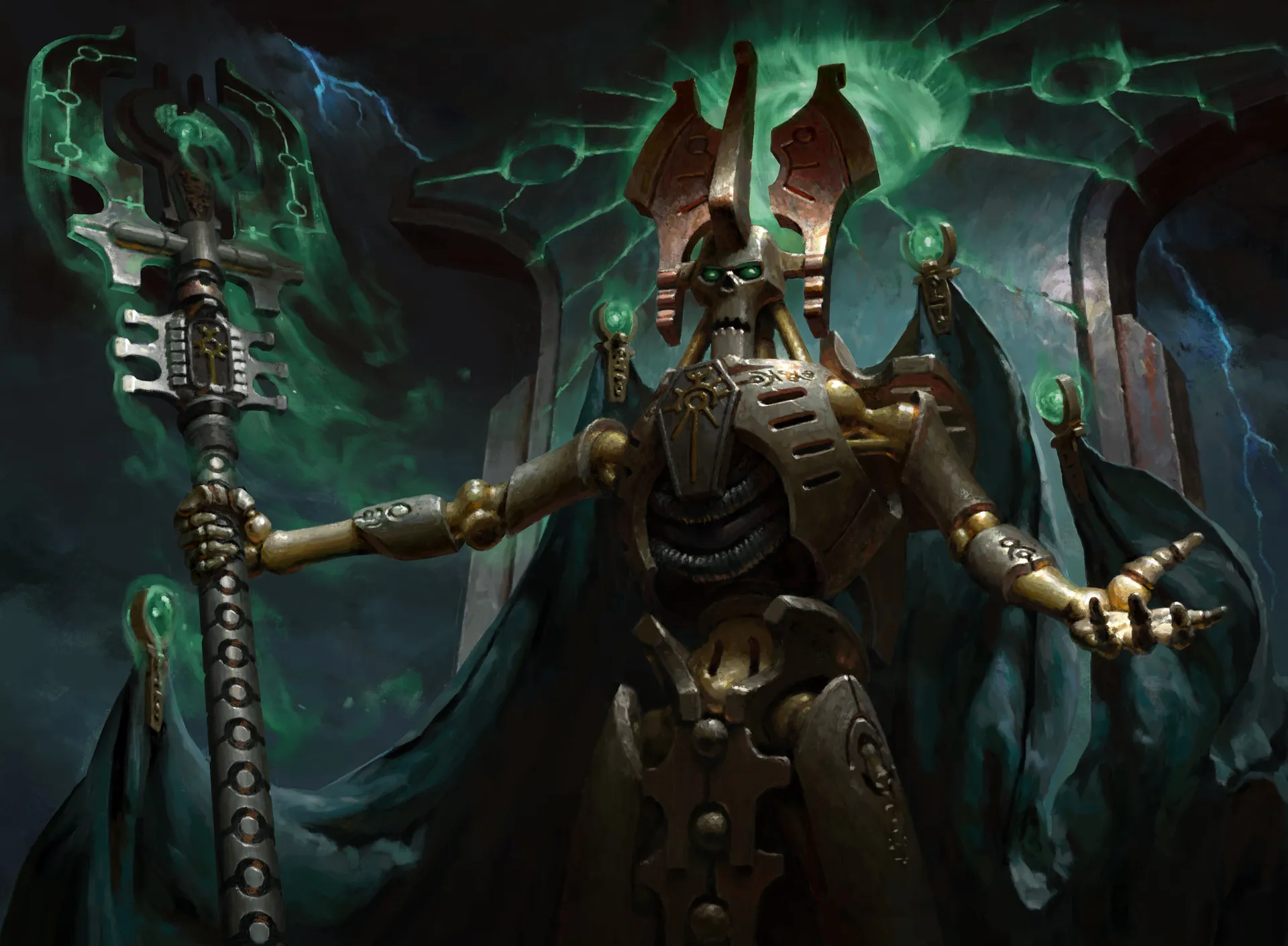
Necrons: Warhammer 40K Lore Guide
The complete lore of the Necrons — the doomed Necrontyr, the C’tan star-gods, biotransference, the War in Heaven, and the deathless dynasties now waking to reclaim the galaxy.
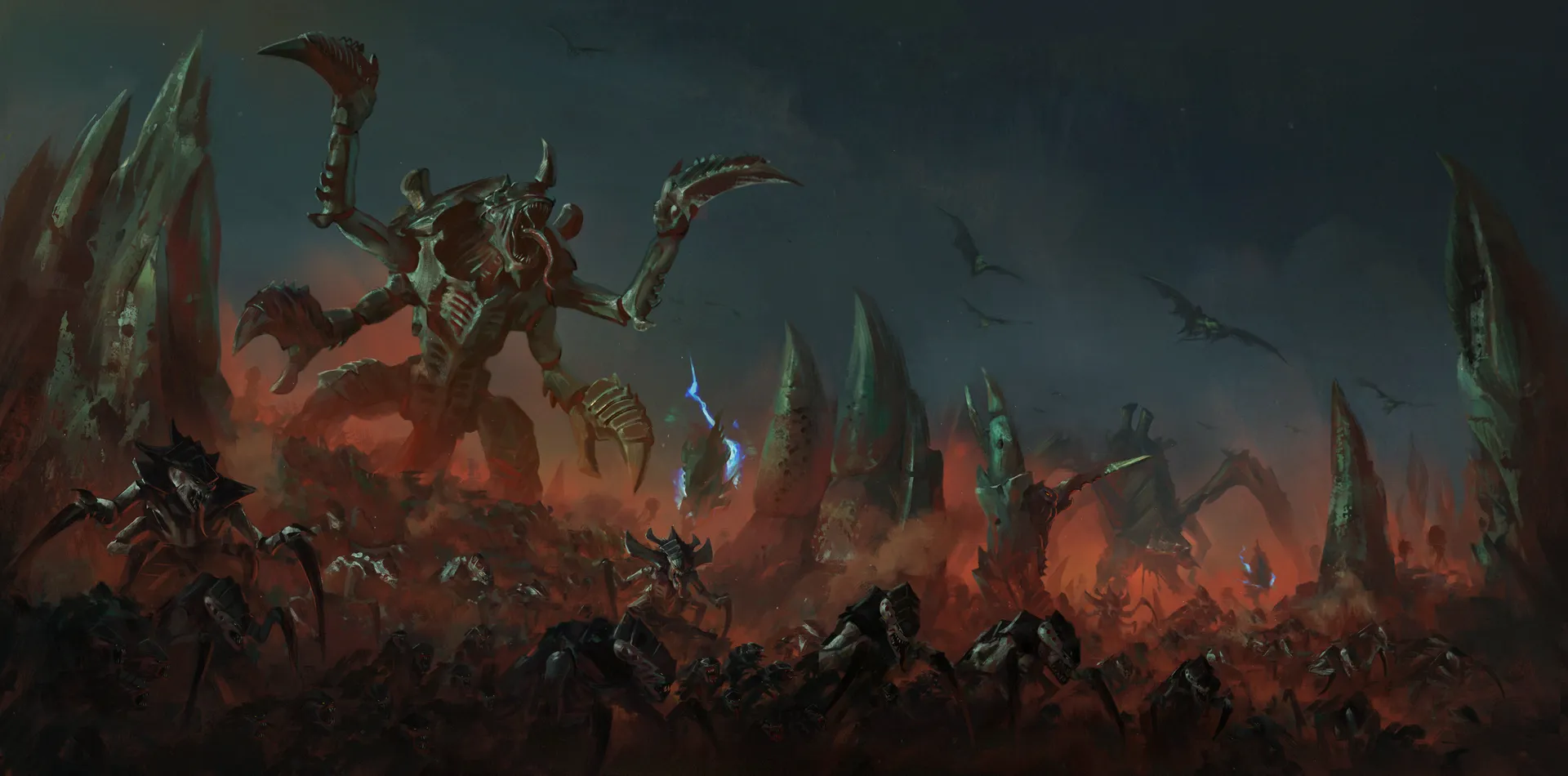
Tyranids: Warhammer 40K Lore Guide
The complete lore of the Tyranids — the Great Devourer, the Hive Mind, the Shadow in the Warp, the great Hive Fleets, Genestealer Cults, and the hunger that crossed the void between galaxies.
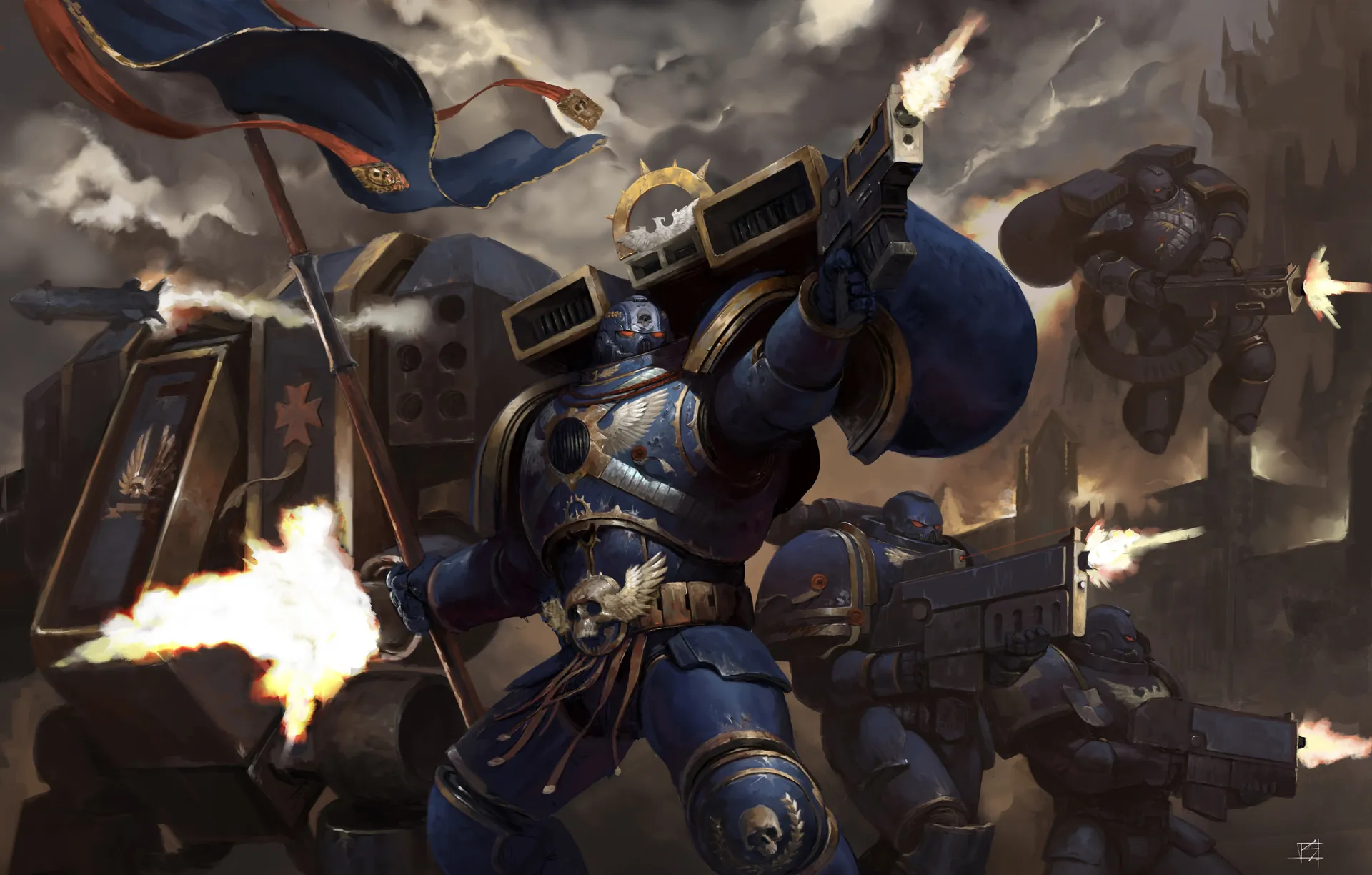
Space Marines (Adeptus Astartes): Warhammer 40K Lore Guide
The complete lore of the Space Marines — the Primarchs, gene-seed, the Horus Heresy, the Codex Astartes and the Chapters, the Primaris and Guilliman’s return, and the cost of the Angels of Death.
Start building your world today
A linked wiki, a timeline and a live DM screen — free, in your browser, no account needed.